


Page 15 - Excerpts from the diary
P. 15
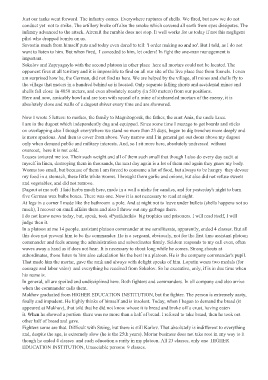
I do not know today’s news, but they say Pyatikhatki has been taken, with large trophies and prisoners. I will read the report myself and
then judge.

There are fourteen men in my platoon. My assistant platoon commander is semi-literate; apparently he completed four classes of school.
Yet none of this prevents him from being a commander. He is a sergeant, evidently not serving as assistant platoon commander for the
first time, and he carries himself confidently with both superiors and subordinates. He rarely even responds when I call him and often
waves a hand as though he has not heard. I have to shout for a long time before he comes. He shouts fiercely at his subordinates; they
obey him, and his crew is the best in the platoon. He is a protégé of the company commander, who made him a mortar man, gave him his
rank, and always speaks of him with delight. Lopatin wears two medals—for Courage and for Labor Valor—and he received everything
from Sokolov. So he is efficient, provided he appears when he is called.

In general, everyone here is spoiled and undisciplined, soldiers and commanders alike. Throughout the company people behave the same
way when a commander calls them.

Makhov graduated from a higher educational institution, yet he is only a soldier. He is an extremely nasty, foul, insolent man. He thinks
very highly of himself and behaves impudently. Today, when I demanded the bread—Makhov had it—he said he did not know whose
bread it was, broke off a crust, and ate it. When he showed me the ration, no more than half a loaf remained. I refused to take it; then he
produced the other half and gave it to me.

Some of the soldiers are like that. Swing is difficult, and then there is Karlov, who is completely indifferent to everything and, despite his
age, extremely slow—he is twenty-five. He cannot get the hang of mortar work at all, although he completed four classes of school, and
that level of education is a rarity in my platoon. Most have two or three classes; only one has higher education; Nelyudimov has nine
classes.
Karlov does like wandering around, “combing” the village in search of food and God knows what else, and because of that he often falls
behind on marches. It would be a pity to send him to the riflemen, but I do not much want to keep him either.

Nelyudimov is quarrelsome and inexperienced at commanding a crew, and lazy besides; otherwise he is a young man—twenty-four—and
educated.

They all think little of me or of their comrades and often leave me without food. Once, yesterday, when the company changed positions
and moved here, they nearly left me behind altogether. Everyone thinks passionately about food for himself and is occupied almost
entirely with personal interests. Whether everyone else dies is no one’s concern. What kind of people are there in the world now?

The replacement crew, as they and their entire crew are called, arrived this month, but there is more comradeship among them and more
concern for common interests. Their whole crew consists of older men. They show much more respect for me and for commanders in
general than the veteran soldiers do. I like this crew, although it is new and inexperienced and literacy is very poor among them—none
has more than three years of schooling.

Later. That is all. The enemy has been driven back. The wedge has extended incredibly far. The Katyushas fired. One of our tanks caught
fire. I saw its crew; they are safe. Shells from enemy tanks skim along the ground and ricochet. Nothing else is flying now—neither
bullets nor shells. The enemy has been driven far away. The infantry and the others are moving forward. Now it is our turn to leave too.

27.11.1943
Yesterday I passed the Divisional Party Commission, and now I am finally a member of the Bolshevik Party. At the commission they
asked me many questions. I was the first to go through. Captain Andreyev, the regimental agitator, tried, at my request, to put me through
first. I answered all the questions smoothly. One question, although it concerned neither the Party Rules nor Party history, seemed the
most difficult.

“You wrote in your questionnaire that you are editor of the wall newspaper. Have you published the wall newspaper here?”

I answered, “Yes, I published it,” although in fact I had not completed the issue of the newspaper: the fighting prevented it. So I had to
lie.

Yesterday I received a letter from Mother and answered her immediately. I sent the hospital certificate.

Our riflemen keep going over to the attack, in the daytime and at night, but without success. The Germans are clinging stubbornly to their
line. Ten more men have been taken from us for the rifle company. I now have six men in the platoon, and I am the seventh: Rudnev,
Lopatin, Dyachenko, Biryukov, Glyantsev, and Musinyan. Six men now serve two mortars.

All night I listened to Rudnev. He knows good songs—songs about love. Under the sound of those songs I remembered civilian life, as
we call it, and felt sorry for my youth, which on its entire road has never known a woman’s love or tenderness.

Yesterday I traded a knife and pen for another pen, a self-filling one. I thought it was better and believed Zarybkin when he said it wrote.
Later, when the deal was done, I saw that it had no pipette. I traded soap with the soldiers for a pipette, but even with it the pen was
useless—the nib was bad.

Later Dyachenko brought me another pen, also broken. I combined the two into one: I moved the tube and tip from Zarybkin’s pen onto
Dyachenko’s and gave Zarybkin’s body to Rudnev.

