


Page 12 - Excerpts from the diary
P. 12
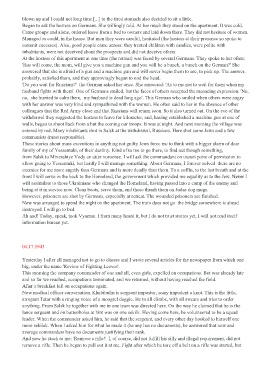
times I had to conduct classes myself, [...] and ask the cadets to listen to Comrade Stalin’s Orders Nos. 195 and 95. Very few wanted to
listen to them. Now the dwarf, freak, and poser Popov has begun complaining to the instructor that I did not read the orders and would
not let anyone else read them either. Yet I gave the orders to about seven men in the barracks.

The commander of our mortar crew, Sergeant Kostenko, is an awful bastard, a racist and a shameless antisemite. Every day he mocks me,
constantly makes me lug the mortar around, and so on. Once he openly said that I was “a Jewish mug,” that “all the Abrams are cunning,”
and the like. Another time, during one of his taunts, I asked him: “What makes me worse than you?” He looked straight into my face and
replied haughtily and insolently: “What do you mean, what? I am Russian—and who are you?!”

Cadet Kruzhilin combines even greater racial nastiness. He calls me “Corn” [sic], “Abram,” and “crooked rifle,” the kind Jews
supposedly like to carry because they do not really want to fight, and so on.

Once, after a discussion with agitators led by a lieutenant colonel, I reported these facts to him. He promised to put an end to such
outrages and did in fact speak about them at a Komsomol meeting. Captain Zakharov and the company and platoon commanders learned
about the matter from the secretary of the Party bureau. Yesterday the Party organizer and I were summoned to the captain. He questioned
both of us in detail about the situation in the company. I told him everything but asked him not to blame our commander, Lieutenant
Satarov, from whom I have never encountered antisemitism; on the contrary, I have seen him combat manifestations of contempt by one
nationality toward another.

26.08.1943
NKO — USSR
ARMY COURSES
for Junior Lieutenants
of the 28th ARMY
Personnel Section
26 August 1943
No. 1/2608

CERTIFICATE

Cadet Vladimir Natanovich Gelfand has been awarded the military rank of Junior Lieutenant by Order No. 0781 of the 28th Army dated
26 August 1943.

CHIEF OF THE PERSONNEL SECTION
Major /SVIDERSKY/

27.09.1943
Regimental observation post. A large, prominent burial mound. The Germans know very well that there is an observation post here. More
than once at night they have sent reconnaissance parties here in search of a “tongue.” Snipers and observers never take their eyes off the
place. They watch it through field glasses and with the naked eye.

The mound is surrounded by a mass of craters from mines and shells. The Germans shelled it furiously, but their shells fell around it, at
the foot of the mound. They did not hit the mound itself. And they do not have enough ammunition. So for the time being they have left it
alone.

I watched the enemy through a stereoscopic telescope. The Fritzes walk freely and openly along their front line at full height. Many are
without shirts, sunbathing; some search one another’s hair for lice. Others hunt them on their bodies—and on their shirts—with such fury
that it seems there must be countless numbers of them.

There are many red-haired men among them, but there are dark-haired ones too. They stand about, smile, then drop into a trench or lie
down on the surface. In the groves they take up positions without digging in at all. They behave carelessly, as though at home.
Observation, however, never stops. One man kept looking through field glasses, then went off to relieve himself and handed the glasses
to another. They change places like that constantly.

In the village they are blowing up a hut and something else. Every day columns of thick white, gray, or reddish smoke can be seen.

01.10.1943
The very first front line of all front lines.

Among us there are different understandings of the word “front line.” Permanent inhabitants of the rear, who have never seen a real front
but for some reason count themselves among front-line soldiers, call “the front line” territory ten to fifty kilometers behind it. Front
rear-area men, who are five to ten kilometers from it, call “the front line” a strip two to three kilometers from the forward lines. And we
mortar men consider “the front line” territory eight hundred meters from the nearest Germans.

But all that, of course, is not the front line in the full sense of the word, because there are still people ahead. The front line, the real one, is
the trench in which I am now. There is not a single one of our men in front of me. In front of me, in a dense growth of trees, in the green
curly grass spread over the ground, among sunflowers, in folds of the terrain and in deep earthen trenches, the enemy is hiding.

