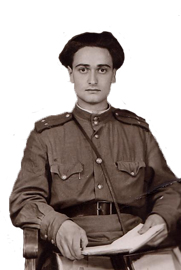


Vladimir Gelfand was a Red Army officer and diarist who took part in World War II. He is known for his diaries about his service in the Red Army (1941–1946), which were published several times in Russian and translated into German and Swedish. It is the first and only personal diary by a Red Army officer available in German.
You can read a detailed biography of Vladimir, his family, and his military service during World War II in the "Biography" section.
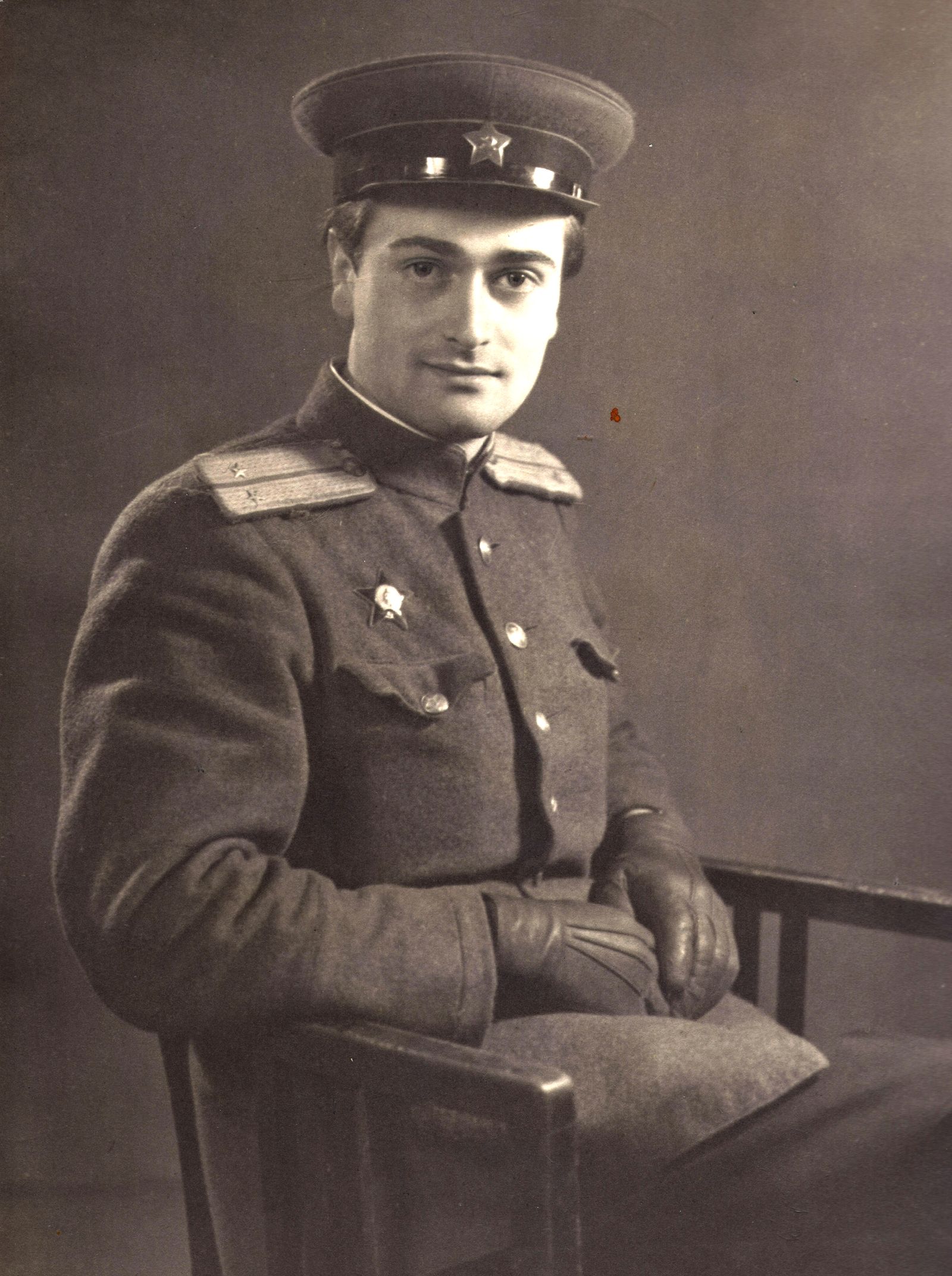
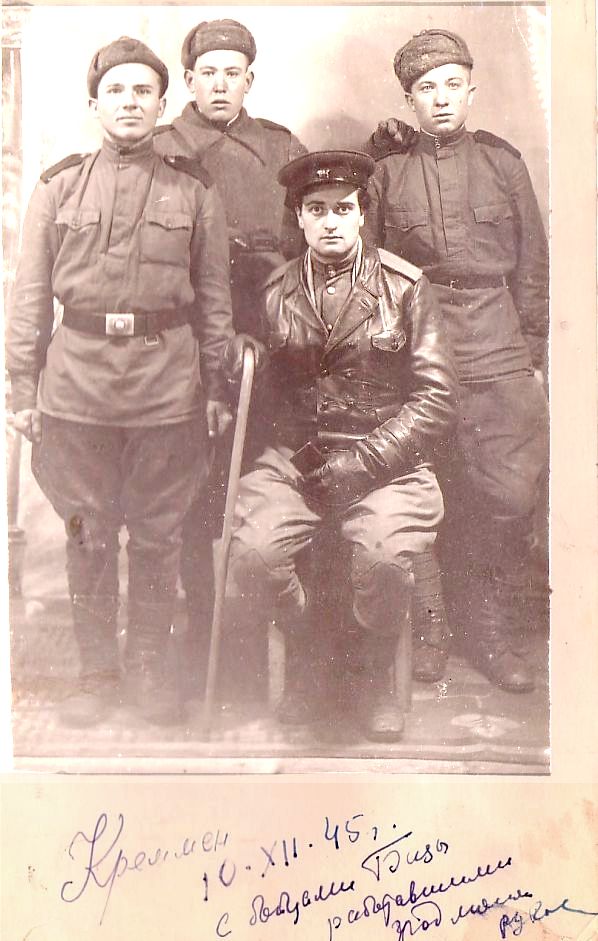
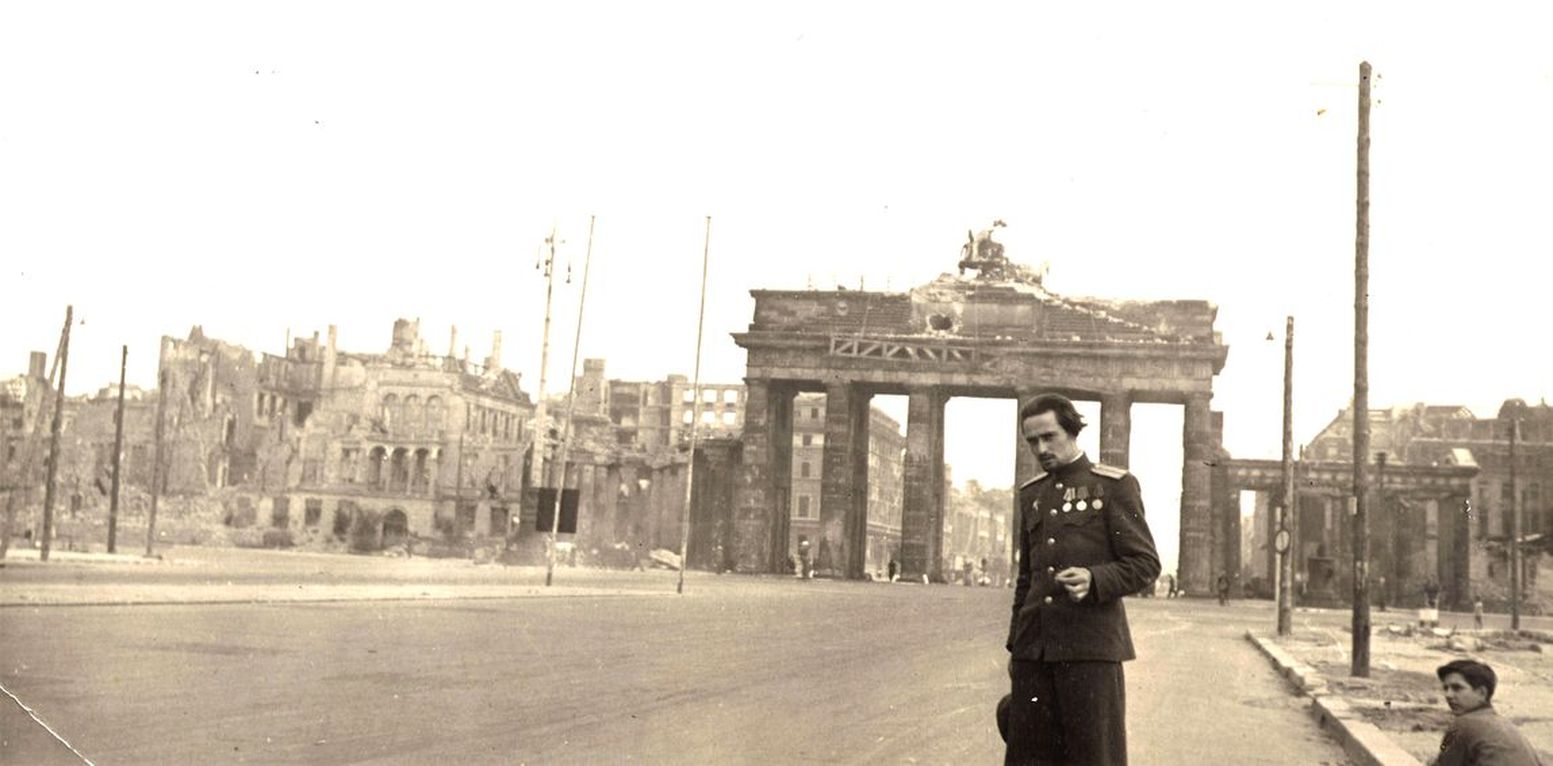
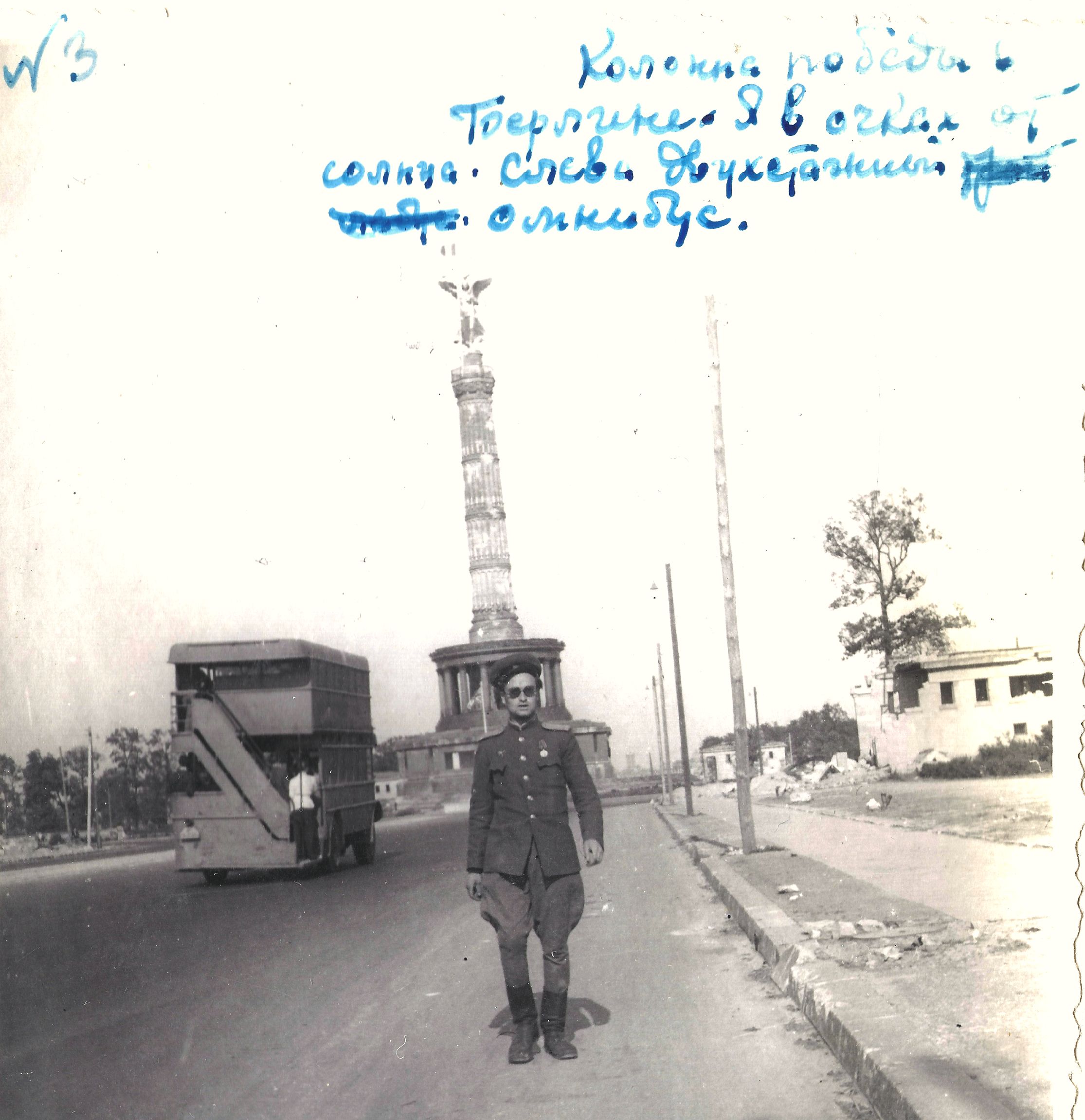
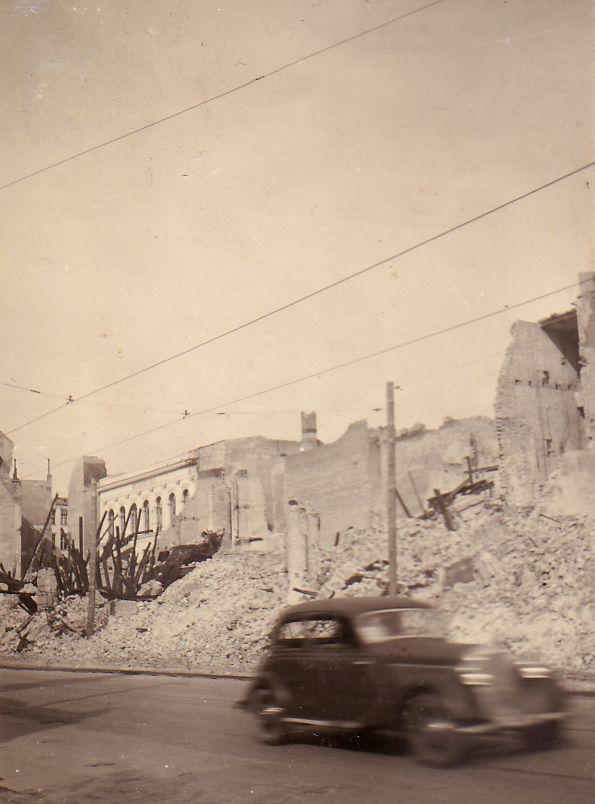
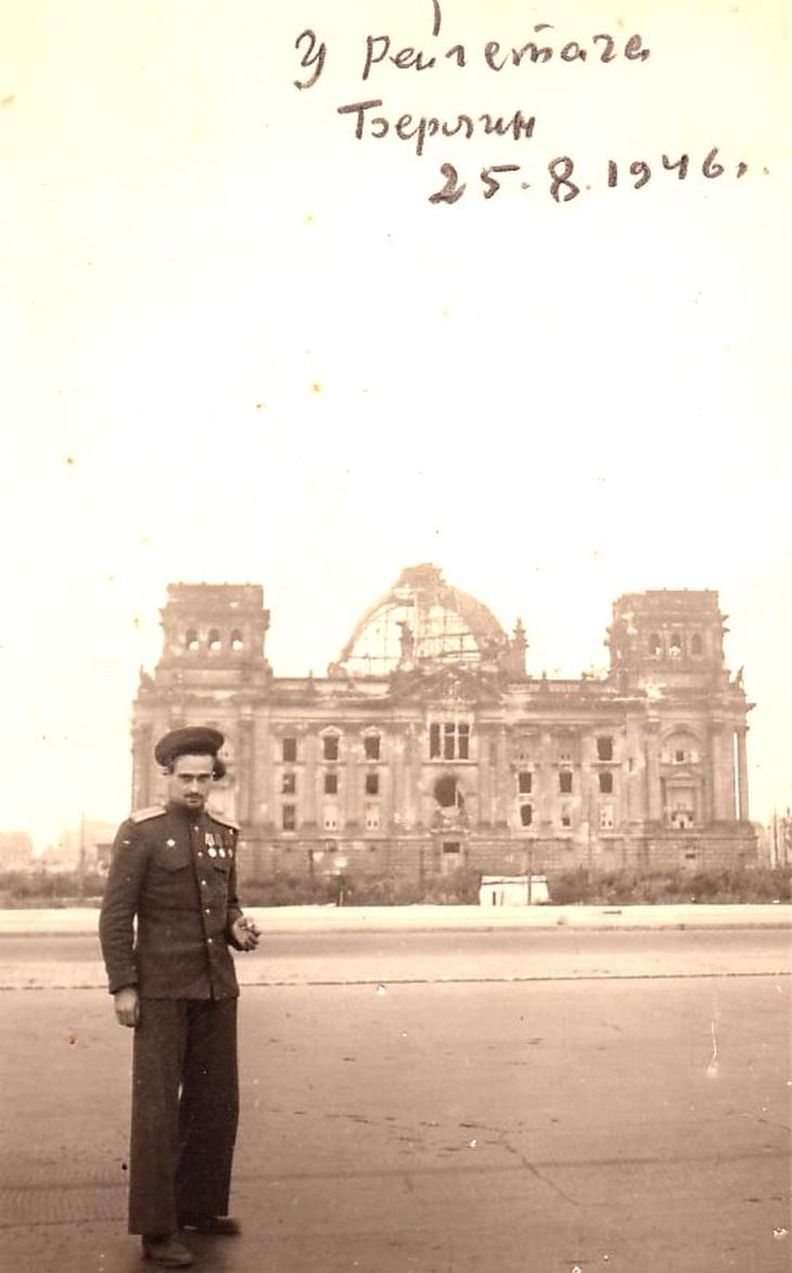
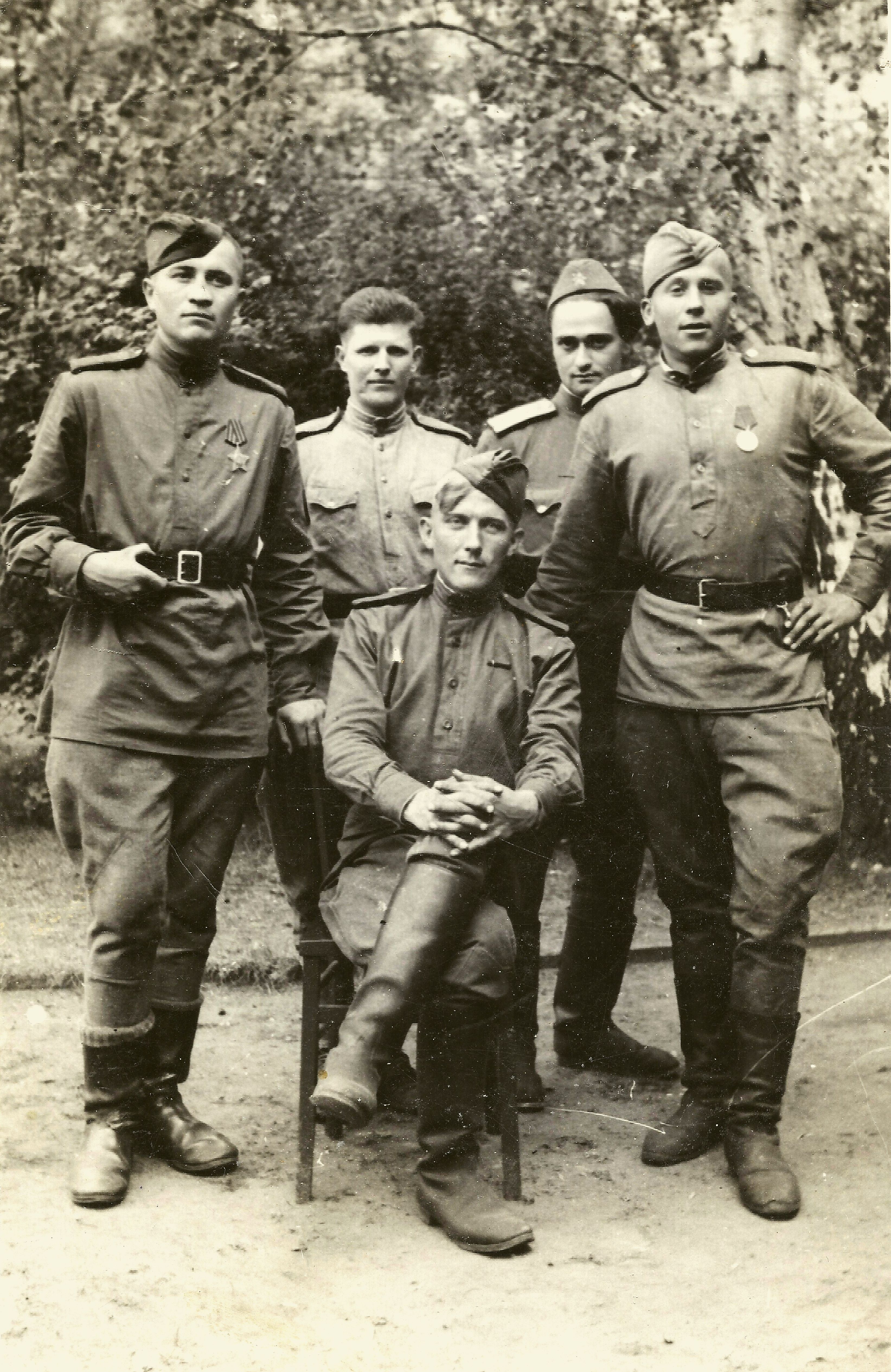
Photos

Diaries and letters
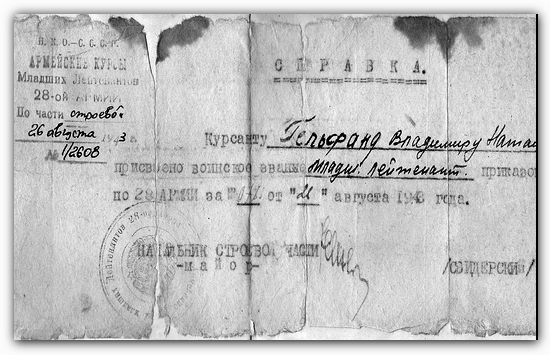
The diary of Vladimir Gelfand can be read at the links below:
Text version
Scans of the Originals

Letters from Vladimir Gelfand can be read at the links below:
Text version
Scans of the Originals
Biography
Childhood and youth
About the family
1923 - 1926Vladimir Gelfand was born on March 1, 1923, in the village of Novoarkhangelsk, Kirovograd Region, Ukraine. He was the only child in a poor Jewish family. Vladimir’s mother, Nadezhda Vladimirovna Gorodynskaya (1902-1982), came from a low-income family with eight children. In her youth, she earned money by giving private lessons. In 1917, she joined the RSDLP(b) and, as Vladimir mentioned in his autobiography, took part in the Civil War. In the 1920s, she was expelled from the party on the grounds of “passivity”. This hindered her career but saved her from subsequent political repression. His father, Nathan Solomonovich Gelfand (1894-1974), worked at a cement plant in Dneprodzerzhinsk. Unlike his wife, he remained non-partisan.
Relocation
1926 - 1933In 1926, in search of a livelihood, the young family moved to the Caucasus. Vladimir and his parents settled in Essentuki, where his paternal grandparents lived, but returned to Ukraine as early as 1928, settling in the city of Dneprodzerzhinsk in the Dnipropetrovsk region. There, his father worked as a foreman at a metallurgical plant and, according to Vladimir's diaries, was a "shock worker". His mother worked as a teacher at a factory kindergarten, which Vladimir also attended. In 1932, she changed jobs and moved to the personnel department of a large metallurgical enterprise. In 1933, the family moved to Dnepropetrovsk.
Parents. Education
1933 - 1941Vladimir's parents separated when he was in school. Nevertheless, he did well in his studies. During his school years, he took an active part in public life: he edited the wall newspaper, organized artistic recitation contests, worked as an agitator and propagandist, and joined the Komsomol. After high school, Vladimir enrolled in the Dnepropetrovsk Industrial Workers' Faculty (now the National Metallurgical Academy of Ukraine), where he completed three years of study before the war began.
World War II
Years of war
1941 - 1945The German attack on the Soviet Union interrupted Gelfand’s education. When enterprises, public institutions, and a significant part of the city’s population were evacuated in August 1941, Vladimir moved to Essentuki, where he stayed with his aunt, his father’s sister. In Essentuki, Vladimir worked as an electrician and had a deferment from military service. Nevertheless, in April 1942 he reported to the military enlistment office, and on May 6 he was enlisted in the Red Army. He trained at an artillery school near Maykop in the Western Caucasus and received the rank of sergeant.
In July 1942, when the Caucasian oil fields became a direct target of the German offensive, Vladimir Gelfand was on the southern flank of the Kharkov Front (as he wrote in his Diary, entry dated 06.16.1942), serving as a mortar squad commander.After the war
1946 - 1983On September 10, 1946, Vladimir Gelfand was demobilized. In September 1947, he began his studies at the Faculty of History and Philology of Dnepropetrovsk State University. In February 1949, he married Berta Davidovna Koifman, whom he had known since school and with whom he had corresponded throughout the war. From August 1952, Vladimir worked as a teacher of history, Russian language, and literature at Zheleznodorozhniki College No. 2 in Molotov (Perm). The marriage soon ran into difficulties. In 1955, Vladimir left his wife and son and returned to Dnepropetrovsk, where he took a teaching position at a college. In 1957, Vladimir Gelfand met Bella Efimovna Shulman
 , a graduate of the Institute of Pedagogical Education in Makhachkala. In August 1958, Vladimir divorced his first wife and married Bella. Living conditions remained difficult. For more than 10 years, the four-member Gelfand family rented a private living space of 10 m². Only in the late 1960s did the family of the war veteran receive a state apartment. Vladimir Gelfand developed health problems. His father died in 1974 and his mother in 1982. Vladimir outlived her by only one year.
You can read the full text here:
About the Diary
"The diary is unique for several reasons. First, because of its chronological scope and the volume of its entries: it begins in the last pre-war months of 1941 and ends with the author's return from Germany in the autumn of 1946, after his service with the occupation forces. Vladimir Gelfand continued to keep a diary after the war, but less systematically; the events described there are more relevant to the history of everyday Soviet life from the second half of the 1940s to the early 1980s, which is a different story. Diaries covering a similarly broad period do exist, although they are rare. I would mention the diaries of Nikolai Inozemtsev and Boris Suris and, among unpublished diaries, that of Vasily Tsymbal. However, Nikolai Inozemtsev served in heavy artillery, which was used mainly during offensive operations and was positioned relatively far from the front line. As a result, he spent much of the war in the rear, waiting for offensives. Boris Suris was a military translator at divisional headquarters and, by the nature of his service, was rarely on the front line. Gelfand — and this is the second feature that makes his diary unique — was a mortarman; during combat he was practically on the front line, with only the infantry ahead of him. Service in heavy artillery required a certain level of education, not to mention staff work. Gelfand's milieu therefore differed significantly from that of Inozemtsev or Suris. These were the most “ordinary” people; many of Gelfand's comrades were poorly educated or even illiterate, and he sometimes wrote letters for them. Third, and perhaps most importantly, the diary is unprecedented in its frankness. When reading diaries, one can often sense a kind of internal restraint: their authors seem to imagine an outside reader and sometimes consciously write with that “external” reader in mind. Gelfand's case is fundamentally different. At times the diary is difficult to read: the author describes his own humiliations and, at times, unseemly actions. With unparalleled frankness, he writes about his sexual problems and “victories,” down to physiological details.
The diary is also unique in another respect: it is perhaps the only currently known text that describes in detail, and without omissions or evasions, the “labors and days” of a Red Army officer in occupied Germany in 1945–1946 and his relationships with Germans, especially German women.
The author of the diary undoubtedly belongs to the category of graphomaniacs. He cannot stop writing; he writes constantly, under all circumstances. He writes letters to relatives and friends (mainly school friends; if he happens to meet a girl somewhere, she too joins the list of his correspondents), as well as poems and articles for newspapers (both regular and wall newspapers). He also writes letters for comrades who have difficulty writing or who want their letters to be written “beautifully”:
“For several days in a row I have been writing letters for other people. I wrote two letters to Nina, the girlfriend of our company commander, Pyotr Sokolov. Then Kalinin asked me to reply to his little daughter, who had asked him to send an article to the local wall newspaper; he did not know how best to answer without hurting her feelings. Earlier I wrote a letter for Rudnev to a girl, two letters to Glantsev’s wife, a letter home for Chipak, and so on.” (01/15/1944).
But the main thing is that Gelfand keeps a diary, which he calls his “friend” (11/07/1941). More than a year later, he writes, referring to the diary:
“Diary, my dear friend! Today I drank tea made from roots! Sweet as if with sugar! Forgive me for leaving you behind! But never mind — you need only smell the roots; here they are in my hands, so that you can be convinced that I am telling the truth. And why would you need any sweets other than mine, when you experience everything together with me — the same joys and sorrows?” (09/03/1942).
Oleg Budnitsky, Doctor of Historical Sciences, Professor, and Director of the International Center for the History and Sociology of World War II and Its Consequences at HSE University
The diary will open in a new window. The menu and page-navigation arrows are at the bottom.
(English)
Excerpts from the diary(the linked version is available only in Russian)
Diary 1941 Diary 1942 Diary 1943Diary 1944 Diary 1945 Diary 1946
Photos by Vladimir Gelfand
01/14/1946
[...] I arrived in Potsdam late — at 8 p.m. The shopping took longer than expected. I bought a camera, a watch, two fountain pens and a cap — half of what I had planned to buy. I looked around a photo studio and visited the photographer. I had my picture taken and left my photographs there to be enlarged.
[...] The camera is a German-made “Agfa.” It is square and black, with a celluloid-like body and an unusual appearance. The lens is recessed and not visible from above. The aperture is small, approximately 7 × 7. One edge is broken, and the joint between the two halves of the body has been crudely repaired with glue. The two catches are white, the colour of steel, and are marked in German “zu” and “auf.” The camera rests on one catch; the other is broken. It has two steel controls for time exposure and instantaneous shooting, a light filter, and two viewfinders for vertical and horizontal photographs. The small red-glass window used to monitor the movement of the film has no cover; it is broken.
The camera uses 6 × 9 film on a wooden spool. Its internal construction is very simple, although its unusual outward appearance commands involuntary respect.
04/21/1946
[...] It happened in a German barter shop. I had exchanged a camera for a harmonica. Just as I was about to leave, a pleasant elderly man with a beard and glasses approached me and asked in Russian whether I had another one: his daughter wanted to exchange an accordion for a camera. I was delighted — the fellows (officers) had asked me to get an accordion, and I had two cameras.
05/22/1946
[...] Today I sold cigarettes and am now going to the tailor. Photographic film is plentiful now. Fixer and developer are available too. The pictures from my camera are not bad. I only need to learn how to develop and fix them, but that requires suitable conditions: a darkroom and someone to teach me. In Velten there is an opportunity to take photography seriously.
[...] Yesterday I photographed the drivers. I deliberately chose historic places; what mattered to me was not so much capturing those grimy fellows on film as capturing Berlin in all its emptiness and grandeur.
06/23/1946
[...] Now I have a new idea: a Leica-type camera for 6,000 marks and a five-tube “Liliput” radio for 4,000 marks. I must obtain both things at any cost.
08/27/1946
[...] I managed to ride quickly to “Agfa” by bicycle and get ten rolls of film, developer and fixer there. Now they promise to transfer us to Rummelsburg, where there will again be a stop, apparently a long and joyless one. Hurry, Berlin, release us from your firm, far-reaching embrace. Or do you want to rival little Ruth in your attachment — she who has worn me out with her declarations of love, entreaties, plans for our future, reproaches and naivety?
09/24/1954
[...] When I returned, a surprise was waiting for me at home: a summons to appear before an investigator. For what reason? I am a little worried — could it be connected with the loss of my belongings, or with old sins involving a camera five years ago? I cannot think of anything else. What if I do not come back? These are frightening, anxious times.
05/11/1965
[...] — There is evidence. A girl from Group 14 herself admitted that you photographed her naked on the beach and showed us a photograph.
— I did not go there alone; I went with the instructor and the whole group. We went to the beach and took photographs of the entire group.
But Borodavkin tried to intimidate me:
— You take them aside and photograph them naked, and then charge 40 kopecks per print.
I replied that I had taken the photographs free of charge, that I had not taken anyone aside, that it had been a cultural outing, and that Borodavkin himself was the one who was “naked.”
Bibliography and media materials
Publications
- "Tagebuch 1941—1946"

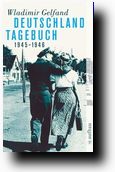
- "Deutschland Tagebuch 1945-1946"

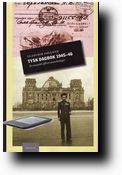
- "Tysk dagbok 1945-46"

- "Deutschland Tagebuch 1945-1946"

- "Tysk dagbok 1945-46"
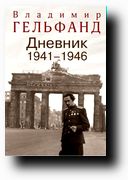
- "Дневник 1941–1946"

- "Дневник 1941–1946"
Bibliography
The author’s personal records gain additional documentary context through visual evidence connected with the events and period described, as well as through the subsequent interpretation of these sources. A large number of excerpts from Vladimir Gelfand’s diaries, his photographs from occupied Germany, and thematic studies of the diaries are contained in books:
OpenCombat Journal of the 301st Rifle Division in the Battle for Berlin
301st Stalin Rifle Division, awarded the Order of Suvorov, 2nd Class. Date of formation — August 1943. Place of formation — Kuban, Slavyansky District, Anastasievskaya stanitsa. Rifle regiments: 1050, 1052, 1054. The division was formed on the basis of two rifle brigades — the 34th and 157th — which arrived in the Kuban from the foothills of the Caucasus after the defeat of the Nazi troops. The division included separate units and subunits: the 823rd Artillery Regiment, the 337th Separate Anti-Tank Battalion, the 757th Separate Communications Battalion, the 592nd Separate Engineer-Sapper Battalion, the 341st Medical Battalion, the field post office, and the divisional field bakery. Division commander — Colonel Vladimir Antonov. The division numbered up to 12,000 soldiers and officers.
You can read the combat journal here:
(the linked version is available only in Russian)
Scans of the OriginalText version
Press Publications
The section contains media materials about Vladimir Gelfand’s diaries. It includes publications from Germany, Denmark, Ukraine, Israel, England, Sweden, Russia, Ireland, the USA, Canada, Greece, Italy, Austria, Spain, France, the Czech Republic, Brazil, Croatia, China, the Republic of Korea, Bosnia and Herzegovina, Hungary, Panama, Peru, Paraguay, Vietnam, Indonesia, Azerbaijan, the Republic of Belarus, the Netherlands, Chile, Mexico, Romania, Turkey, Estonia, Latvia, Slovakia, Poland, Uzbekistan, Finland, Georgia, Iran, Iraq, India, Egypt, Portugal, Albania, Belgium, Argentina, and Singapore. On the media page, the publication titles are listed as separate lines; each line links to the corresponding publication page. The materials are arranged chronologically, from the earliest to the most recent.

“The diary of a Soviet soldier describes a reality that was suppressed for a long time and whose everyday circumstances had never been portrayed. Despite all the horrors it contains, it is compelling reading, finally published after many years. It is extremely gratifying that the diary has been made available to a broad readership, even if only in German and sixty years late, because this was precisely the perspective that had been missing. For the first time, the victorious soldiers of the Red Army are portrayed as human beings, giving us insight into the inner world of a Soviet soldier. It will not be easy for Putin and his post-Soviet followers to lock this diary away in a poison cabinet labelled anti-Russian propaganda.”
Per Landin, Sweden, "Det oändliga kriget", in: Dagens Nyheter
“Gelfand’s Germany Diary 1945–1946 is remarkable in many respects. From an unusual perspective, an eyewitness describes the liberation of Poland and eastern Germany by the Red Army. The very fact that the book exists is reason enough to be grateful to its author, because Red Army soldiers were forbidden, for security reasons, to keep diaries. The Ukrainian lieutenant Vladimir Gelfand nevertheless had the courage to disregard this ban. Despite its imperfections, the diary stands in some contrast to the view advanced by numerous historical revisionists that humanity’s great victory over Hitler was an assault by Stalin’s hordes on Western civilisation.”
Stefan Lindgren, Sweden, "Dagbok kastar tvivel över våldtäktsmyten", in: Flamman
“These are very private, uncensored accounts of the experiences and moods of a Red Army soldier and occupier in Germany. At the same time, they reveal how the young Red Army soldier saw the end of the war and the collapse of German society. We gain entirely new insights into the military community of the Red Army and its moral condition, which Soviet accounts all too often glorified. Gelfand’s diaries also run counter to the frequently advanced thesis that the Red Army’s military successes were due primarily to systemic repression. His experiences with women likewise show that in 1945–1946 there could be affectionate relationships between male victors and female members of the defeated population. The reader is shown convincingly that German women also sought contact with Soviet soldiers — and not merely for material reasons or out of a need for protection.”
Dr. Elke Scherstjanoi, Institut für Zeitgeschichte München-Berlin
“Among the many eyewitness accounts of the end of World War II in Germany, the diary of a young Red Army lieutenant who took part in the battle for Berlin and remained in the city until September 1946 appeared in 2005. Vladimir Gelfand’s Germany Diary attracted considerable media attention, and the commentary surrounding it cast new light on existing German accounts of the fall of Berlin and on relations between the Soviet occupiers and the German civilian population.”
Anne Boden, Trinity College Dublin, Bradford Conference on Contemporary German Literature
“Gelfand’s diary captures the mood of Soviet soldiers in the final phase of World War II and in the immediate post-war period. As a Jew of Ukrainian origin, the author directly reflects the growing desire for revenge that spread among the troops involved in the Vistula–Oder operation, as well as hatred of an enemy increasingly identified with the German people as a whole. Gelfand witnesses destruction, looting, death and betrayal. The diary records several episodes of violence and rape against German women. He is both a sensitive observer and a participant, and he does not attempt to conceal acts of revenge or looting. Gelfand’s diaries are a unique chronicle of the Soviet occupation of Germany.”
Università Ca' Foscari, Venezia "Stupri sovietici in Germania (1944-45)", Matteo Ermacora e Serena Tiepolato
Open