


Page 40 - Excerpts from the diary
P. 40
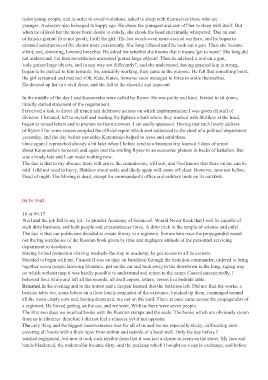
we stopped, she shook my hand, pressed close to me, and her cheeks flushed. That was when we kissed for the first time.

The next day, at the appointed hour, she let me into the apartment. Her mother had been prepared in advance and, despite her bad temper,
received me kindly, though suspiciously.

The next time I came, Margot was crying. Her mother looked angrily at me and sullenly at the girl. I was embarrassed and angry at the
same time. On the one hand it was unpleasant to be the cause of a family conflict; on the other, it irritated me that this nasty old German
woman was scolding and oppressing an innocent little girl. With difficulty I calmed them both and decided privately not to come to the
apartment again.

The next day, however, I received an extra ration, visited Velten, and on returning to the town decided once more to try my luck in love.

But I was not born to be happy. The mother was delighted with the food, just as I had expected the day before, but her behavior and greed
exhausted my patience and poisoned so many feelings in me that even my affection for Margot was half extinguished.

I gave the mother a full jar of fat and suggested frying potatoes so that we could all have supper together. She seized it in both hands,
emptied the contents onto a plate, then licked the spoon and her fingers and scraped the jar dry. There was already a little liquid in the
frying pan. I came over with a knife, cut off a slice of the fat I had brought, and was about to put it into the pan when the old woman
sprang up, flew at me, and with a crazed shout tried to snatch it away.

“What is the matter?” I asked in surprise. “Warum?”

She explained that the fat was to be kept for tomorrow and the following days—for herself—and that today I was to eat her thin gruel.

That did not suit me. I knew decent people did not behave that way, and my indignation knew no bounds, but I [...]
restrained myself and, smiling as though I had noticed nothing, put the piece of fat into the frying pan anyway. The German woman
closed her eyes and sighed.

I began washing what I had brought with me; she asked for some. I cut off a piece. Once again she seized it with all her fingers and held
it tightly, as though afraid it might escape. When we had eaten, I suggested that everyone drink tea. The old woman insisted that she had
neither tea nor coffee. I had cocoa. I gave her the whole bar, and she hid it away again, breaking off only a barely noticeable piece into
the teapot, such was her greed.

I put out some honey and treated Margot’s little sister. Then I offered some to Margot. She refused. Her mother immediately ordered her,
cynically: “Take it! Why are you refusing? Are you sorry for him?!” I felt ashamed of myself for ever having come into this house and
humiliated myself to the point of drinking tea with this old scoundrel, even if she was the mother of a beautiful girl.

Still I kept myself under control and persuaded Margot to drink tea, though she did not need much persuasion. I gave her a spoonful of
honey. She ate it at once and then drank the cocoa unsweetened. I asked why she was doing that, but her mother did not let her answer
and whispered behind her back, “More, more.”

She ate two or three spoonfuls and again drank tea without sugar. This especially disgusted me because I felt she was doing it deliberately
to please her mother—and to eat more honey.

The old woman made sure not to deprive herself either. She seized a large tablespoon and scooped it full, emptying a good portion in one
go.

When the meal was over, I asked about my shoulder boards—whether she could sew red piping around them. I received the undeserved
answer that she had no time now because there was too much work.

“Well,” I concluded, “I’ll take tobacco to a tailor, and he’ll do the job for me by midday.”

12.01.1946
To the Head of the Supply and Defense Base,
Major Skorkin

From Assistant Head of the Transport Department,
Lieutenant V. N. Gelfand

REPORT

I ask you to take note that I am entirely without winter uniform and am compelled, under winter conditions, to wear a German raincoat, a
tunic made from German material at my own expense, old boots, and wide summer trousers.

The Base administrative section, acting through its chief, First Lieutenant Smirnov, categorically refuses to issue me winter uniform for
the simple reason that my clothing certificate contains one correction in the section concerning summer uniform. The correction was
made by the unit from which I received the clothing, whose prescribed period of wear means that no further summer uniform is due to me
until summer.

