

|
||
|
|
Самое удивительное в этом тексте — это вопрос, откуда солдат берет свое чувство превосходства? На каком основании он чувствует право использовать насилие и не уважать других людей, когда власть и авторитет не подтверждены уважением? В своем письме от 17 мая 1942 года, солдат пишет, что 'если еврей видит нас уже на расстоянии 100 метров, он снимает шляпу'. Если он этого не делает, его 'наказывают'. Это небольшое замечание вызывает много вопросов: почему солдат ощущает превосходство и воспринимает себя выше других? Почему дискриминация становится нормой, а насилие — естественным?
Эти слова, с одной стороны, выражают субъективное мнение одного солдата в определенной исторической ситуации, но с другой стороны, они служат документом коллективного восприятия, укоренившегося в немецком обществе при нацизме. Это подтверждается и в других источниках, включая военные письма, дневники солдат и частные фотографии, которые обеспечивают уникальный взгляд на менталитет того времени. Этот взгляд помогает понять, как механизмы пропаганды и идеология были внедрены через средства массовой информации, личные встречи и повседневное общение.
Тема насилия в войне часто остается нераскрытой, так как простое объяснение через дисциплину или командный приказ не может полностью объяснить такие деяния. Важно исследовать, какие социальные убеждения и идеологии стояли за действиями солдат, и каким образом повседневные идеи и убеждения помогали создать пространство для массового насилия. Речь идет о психологическом и социальном контексте, который позволил нормализовать насилие.
Генерал, солдат вермахта или полицейский — все они подвергались внешним и внутренним факторам, которые могли способствовать насилию. Но это также касается того, что делали солдаты, которые отказывались следовать преступным приказам. Многие солдаты вермахта, например, несмотря на приказы, избегали убийств, что свидетельствует о наличии моральных границ. Исследование посвящено тому, как психологические, идеологические и социокультурные факторы формировали решения солдат и участников военных преступлений.
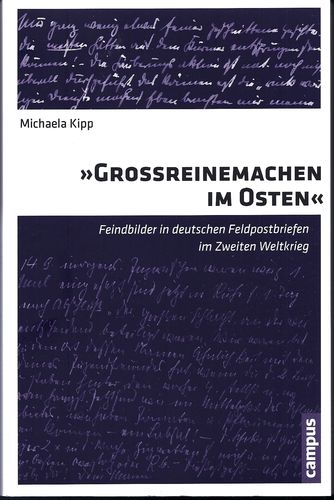
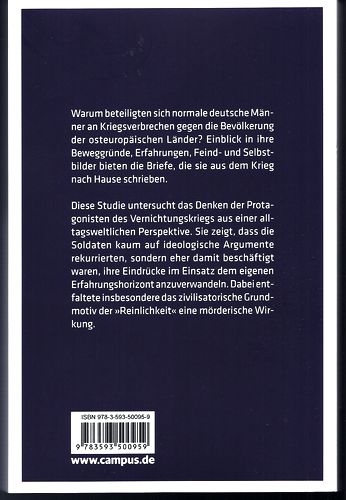
| Почему нормальные немецкие мужчины были вовлечены в военные преступления против народов Восточной Европы? Понимание мотивов членов вермахта можно найти в письмах, которые они писали домой во время войны. На основе качественного анализа около 7000 писем Михаэла Кипп рассматривает мышление солдат, участвовавших в войне на уничтожение, и функционирование военной машины через повседневный опыт «обычных людей». Анализируя этот опыт, автор приходит к выводу, что солдаты редко опирались на прямые идеологические аргументы. Гораздо больше их интересовала попытка осмыслить свои впечатления и адаптировать их к собственному миру опыта. В этом контексте основным мотивом насилия и убийств становится разрушение цивилизационных норм и стремление к «чистоте». |
 |
|
Ergebnisse für Gelfand
Seite 476 ... Bd. 26), Detmold 2008. Gelfand, Wladimir, Deut… |
 |
 German
“A Great Cleanup in the East: Images of the Enemy in German Field Post Letters during the Second World War”
Introduction: War as the Appropriation of Reality
A central question raised by the material is where a soldier's sense of superiority came from. On what basis did he feel entitled to use violence and deny respect to other people when power and authority were not grounded in mutual respect? In a letter of 17 May 1942 one soldier wrote that “if a Jew sees us from as far away as one hundred meters, he takes off his hat”; if he failed to do so, he was “punished.” This small remark opens a much larger set of questions about hierarchy, discrimination, and the normalization of violence.
Such words were, on one level, the subjective judgment of an individual soldier in a particular historical situation. At the same time they document forms of collective perception that had become rooted in German society under National Socialism. Other sources — soldiers' letters and diaries, private photographs, and everyday communication — make it possible to examine how propaganda and ideology were translated into ordinary habits of seeing and acting.
Violence in war cannot be explained completely by discipline or command orders alone. It is necessary to ask what social convictions and ideologies stood behind soldiers' actions and how everyday assumptions created room for mass violence. The issue is the psychological and social context in which violence could become normal.
Commanding generals, Wehrmacht soldiers, and policemen were all exposed to external and internal forces that could facilitate violence. At the same time, there were soldiers who refused to carry out criminal orders, demonstrating that moral boundaries continued to exist. The study therefore asks how psychological, ideological, and sociocultural factors shaped decisions by soldiers and perpetrators.
Why did ordinary German men become involved in war crimes against the peoples of Eastern Europe? Soldiers' field post letters offer access to their motives. On the basis of a qualitative analysis of about 7,000 letters, Michaela Kipp examines the thinking of soldiers who participated in the war of annihilation and the workings of the military machine from the perspective of the everyday experience of “ordinary men.” Her conclusion is that soldiers often relied less on explicit ideological arguments than on attempts to interpret what they saw and fit it into their existing world of experience. In this context, the destruction of civilizational norms and the desire for “cleanliness” became important motifs in violence and killing.
Michaela Kipp, PhD, is a research associate at the University of Göttingen.
Acknowledgments
The study was accepted by the Faculty of History, Philosophy and Theology at Bielefeld University in 2009 as a dissertation. The text was revised and shortened for publication. The author thanks her supervisor Heinz-Gerhard Haupt for his continuing confidence and for the opportunity to spend time at the European University Institute in Florence; Willibald Steinmetz for valuable comments and a second perspective; Sven Oliver Müller for intensive and knowledgeable support and help in working through several hundred letters; and Frank Werner for shared reflection and discussion. Evangelisches Studienwerk Villigst provided a generous doctoral scholarship and broad intellectual support.
Thanks are also due to Klaus Holz for professional advice and constructive cooperation; Martin Humburg and Klaus Latzel for readily sharing their experience; Andreas Ruppert of the North Rhine-Westphalia State Archive, East Westphalia-Lippe Department, and Thomas Jander of the Museum of Communication in Berlin for archival assistance; Katja Kosubek for copies of letters; the Geschwister Boehringer Ingelheim Foundation for publication funding; and Arnd Meyer for guidance during the final revision. The author also thanks the many other colleagues and supporters who cannot all be named individually, and especially Eberhard Orland for professional proofreading and for much more that is difficult to put into words.
Hildesheim, December 2013 — Michaela Kipp
© Campus Verlag