Red Army Soldiers and German Women
“I Only Go Out with Decent Russians”
After the war, the Jewish Red Army soldier Vladimir Gelfand lived in
East Germany for a year and a half. He took bicycle trips through
Brandenburg, photographed ruined Berlin — and received love
letters from German women.
Martin Pfaffenzeller
14 July 2020
“My dear Waldemar!” — that is
how a woman named Margo began her love letter on January 31, 1946. She
asked her Waldemar to visit her again soon in the Berlin suburb of
Hennigsdorf and mentioned his birthday. She hoped to see him
“soon” and ended with the words: “Greetings and
kisses from your dear Margo.”
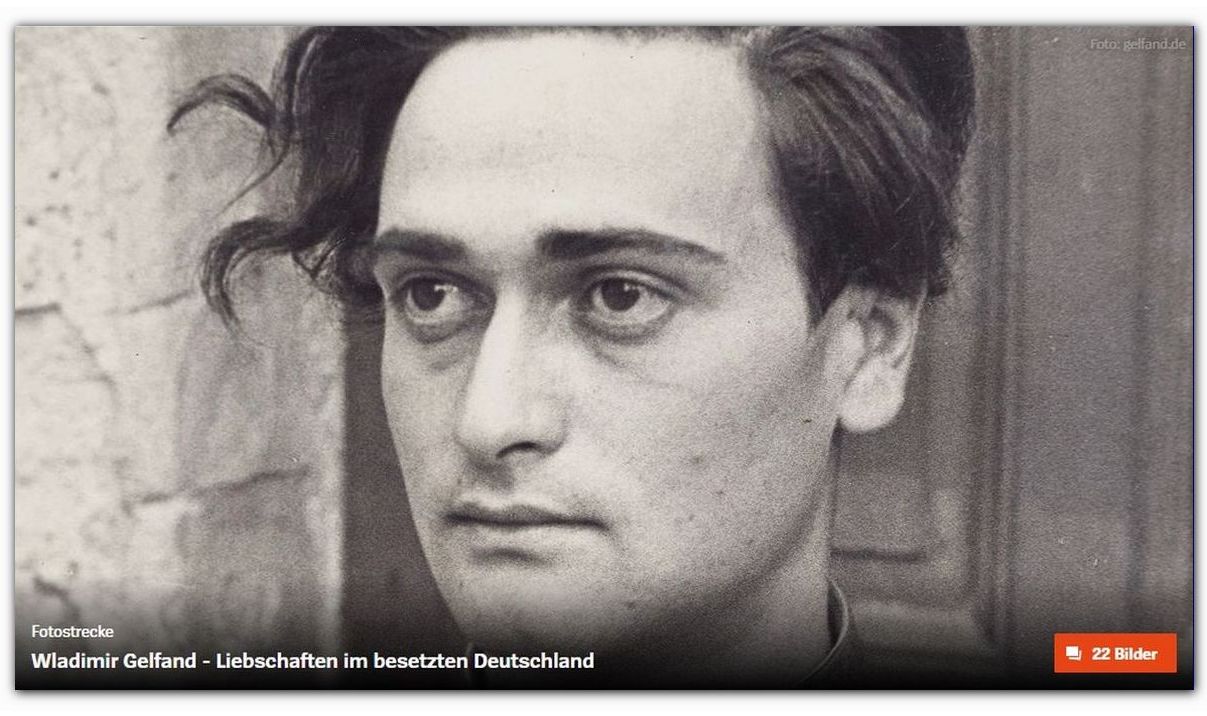
1 / 22 — Volunteer: Vladimir Gelfand
(here in an undated portrait) joined the Red Army in the summer of
1942. He later learned that the SS had murdered his grandmother, two
aunts, an uncle and cousins. Photo: gelfand.de
2 / 22 — Victor: In April 1945 the Red
Army reached Berlin; in May the Wehrmacht surrendered. The photograph
shows Gelfand and two other officers in the Berlin-Tempelhof district.
Photo: gelfand.de
3 / 22 — Romance: During his stay in
East Germany, Gelfand had several love affairs with German women,
although Red Army soldiers were in fact forbidden to have contact with
the population. In this undated photograph he is shown with a
girlfriend and her younger sister. Photo: gelfand.de
Waldemar was only the pet name used by Margo for
her lover. His real name was Vladimir Gelfand. He had been born in the
Soviet Union and served as a Red Army lieutenant in occupied East
Germany.
The letter evidently meant a great deal to
Gelfand, because he took it home and kept it in a suitcase until his
death, together with other letters, photographs and his diary. These
mementos reveal mutual affection in his relationships with various
women.
Historian Elke Scherstjanoi translated Gelfand's
diary into German and published it. She says: “The diaries show
that in 1945/46 there were love relationships in the East between the
victorious men and the defeated women.” Yet the young Red Army
soldier had strong reasons to reject everything German.
4 / 22 — Destruction: After the Battle
of Berlin the capital lay in ruins. Gelfand photographed various
buildings, including the Stettin railway station. Photo: gelfand.de
5 / 22 — Distinction: Gelfand was
awarded the Order of the Red Star for his service (undated photograph).
Photo: gelfand.de
6 / 22 — Together on the grass:
Gelfand went on outings with girlfriends. In this undated photograph he
is resting in a meadow. Photo: gelfand.de
The Nazis murdered Gelfand's grandmother, aunts, uncle and cousins
When Adolf Hitler's armies invaded the Soviet
Union in 1941, Gelfand was 18 years old and was attending school in
what is now eastern Ukraine. His parents were Jewish, though they
rarely practiced the religion. His mother had joined the Communist
Party after the 1917 Revolution. SS men murdered his grandmother, his
uncle, two aunts and two female cousins. He and his mother managed to
flee the National Socialists to the Caucasus. Vladimir, who actually
wanted to become a writer, left school and volunteered for the Red Army.
7 / 22 — Officer: Gelfand commanded a
mortar platoon and rose to the rank of lieutenant. The photograph shows
him in December 1945 in Kremmen, Brandenburg, with the caption:
“with soldiers who work under my command.” Photo: gelfand.de
8 / 22 — In uniform: Gelfand also
liked to wear his uniform and medals at private meetings. In the
photograph he is walking arm in arm with two women. Photo: gelfand.de
9 / 22 — Occupier: Gelfand remained in
Berlin and its surroundings until September 1946. The photograph shows
him in front of the damaged Brandenburg Gate. Photo: gelfand.de
After brief training, Gelfand was given command of
several soldiers and a mortar. He marched, fought, froze and went
hungry. Everywhere he went he carried notebooks in which he kept a
diary — even though this violated army censorship rules. After
the war he hoped to use his notes to write a war novel.
Gelfand described in detail the lice living on his
body: “Really splendid specimens; they are still eating
me.” He recorded how soldiers drank, refused to obey orders,
looted, secretly manoeuvred for promotion, quarrelled and fought.
Researcher Scherstjanoi considers the diary a reliable source:
“Never before have we been able to penetrate so deeply into the
thoughts of a Red Army soldier in occupied East Germany.”
10 / 22 — In the surrounding area:
Gelfand explored the Berlin region on official trips and excursions.
The photograph shows him sitting on a fence in the village of Caputh,
Brandenburg. Photo: gelfand.de
11 / 22 — Excursion: In his free time
Gelfand played football, took photographs and learned to ride a bicycle
(undated photograph). Photo: gelfand.de
12 / 22 — Author: Gelfand really
wanted to be a writer. During the war and occupation he kept a diary so
that he could later turn his experiences into a novel. He also
maintained extensive correspondence with family and friends. Photo:
gelfand.de
He “sinned” for the first time
In the final days of the war, at the end of April
1945, Gelfand mentioned an encounter with a young woman from Berlin who
had been raped the previous night by several Red Army soldiers.
According to scholarly estimates, Soviet soldiers raped around one
hundred thousand women in Berlin alone.
Sexual violence against women had devastating
consequences: thousands became pregnant, thousands died as a result,
many were traumatized for life and stigmatized by relatives and
acquaintances. Gelfand wrote that the young Berliner offered him sex if
he could protect her. But he chose “soldier's duty” instead
— without explaining what he meant by that.
After the German surrender on May 8, Gelfand
enjoyed the peace: “Today I slept until 11 in the morning. A day
off, music, volleyball, football.” By then the 22-year-old had
apparently learned a few words of German, because he now frequently
described conversations with German women: “They said I looked
Italian and said I had very black hair.” A little later he wrote
about his first kisses.
On June 24 Gelfand noted in his diary that for the
first time he had “sinned.” He approached a
“lady” with reddish hair and asked whether she wanted to
come into his apartment with him. She replied: “What would I do
there?” — “Read books.” — “But that
is boring.” The unnamed woman then went to bed with him.
A few weeks later Gelfand was seeing Marianne more
often, but they exchanged no more than kisses and embraces. “I
hoped for more, but I did not want to pressure her,” he noted.
Her mother had already approved of their relationship — because
he gave the family butter, sausage and cigarettes. Along with his charm
and attractive appearance, his food rations and pay evidently made him
desirable.
13 / 22 — Mementos: Vladimir Gelfand
documented his stay in Germany with photographs. On this picture he
wrote: “Victory Column in Berlin. I am wearing sunglasses; at the
left, a double-decker omnibus.” Photo: gelfand.de
14 / 22 — Proud: Gelfand was also
photographed on Berlin's East-West Axis, today's Straße des 17.
Juni. His caption reads: “Memorial to Red Army soldiers who fell
in the battles for the city. In the background, the Reichstag and
buildings in central Berlin.” Photo: gelfand.de
15 / 22 — Knowledge of German: Gelfand
gradually learned German — apparently well enough to read the
newspaper Neues Deutschland, which had been published in the Soviet
occupation zone since April 1946. Photo: gelfand.de
“I am no longer schoolboy Vova”
His romances clearly irritated his superiors.
According to the diary, a senior officer reprimanded him in front of
the assembled unit: “Gelfand, whose family was killed by the
Germans, is now having himself photographed with German girls, keeping
their photographs and enjoying himself with them.” The military
leadership had forbidden soldiers to have contact with the population
as early as August 1945 — on that occasion Gelfand was not
punished.
In letters to his parents, Gelfand spoke quite
openly about his romantic adventures. “As for girls and love, I
can assure you: I am no longer that schoolboy Vova who fell in love,
trembled and lost his head,” he wrote to his mother. His father
once expressed displeasure that his son was involved with non-Jews. But
Gelfand replied: “I have never thought about the nationality of
the woman I love. Nor do I consider it possible that the woman I choose
could be so unreasonable and backward as to attach importance to
national differences.”
Like many Jews of his generation in the Soviet
Union, Gelfand was a committed Communist. The early Soviet Union had
made social advancement possible: unlike in the Tsarist Empire, Jews
could become Red Army officers. Historian Norman Salusa, who researches
Jewish Red Army soldiers, even speaks of a “Jewish-Soviet love
affair” — one that was to end with the wave of antisemitic
purges beginning in 1948.
16 / 22 — A playful pose: The Red Army
soldier repeatedly photographed himself in different outfits. This
photograph with a hat was taken in the village of Caputh... Photo:
gelfand.de
17 / 22 — ...just like this photograph
with a top hat. Gelfand sent many photographic prints to his family or
exchanged them with German acquaintances. Photo: gelfand.de
18 / 22 — Invitation to a date: the
initiative evidently also came from the women, as this rhymed letter
from Gelfand's collection shows... Photo: gelfand.de
19 / 22 — ...the letter's author,
Helga, was apparently startled by her own directness and added a
postscript after the poem. “Gerhard” was probably an
adaptation of his surname. Photo: gelfand.de
20 / 22 — A new acquaintance: Gelfand
wrote in his diaries about several German lovers. Photographs preserved
in his estate also show a number of different women. Photo: gelfand.de
Affairs with Hilda, Kriemhild and Nora
Gelfand remained in the Berlin area until the end
of September 1946, guarding reparations shipments. During that period
he grew his hair, took photographs and learned to ride a bicycle. He
had affairs with Hilda, Kriemhild and Nora — and with Margo from
Hennigsdorf, who called him Waldemar. Meanwhile, he contracted a
venereal disease.
Historian Scherstjanoi concludes: “German
women sought contact with Soviet soldiers not only for material reasons
or because they needed protection.” The best example is Helga,
who fell in love with Gelfand and invited him to a date in writing:
“Do not think that I am a bad girl. I only go out with decent
Russians, and I assume that you are one of them.”
After returning to eastern Ukraine, Gelfand
continued his studies, married, became a vocational-school teacher and
had two children. He let his diaries, photographs and letters from
Germany gather dust in suitcases. Only after his death in 1983 did his
son Vitaly rediscover the documents and secretly type them up, fearing
Soviet censorship. After moving to Germany in the 1990s, he published
them. Since then, relatives of three of his father's former girlfriends
have contacted him. Vitaly Gelfand says: “We exchanged letters
and ate cake.”
21 / 22 — Intimate matters: Gelfand
apparently also spoke with his girlfriends about his family, as this
undated love letter shows. Some of his lovers Germanized his name,
calling him Waldemar instead of Vladimir. Photo: gelfand.de
22 / 22 — With love from Hennigsdorf:
this letter from January 1946 shows how important photographs were to
Gelfand and his contemporaries. In September of the same year, the Red
Army soldier finally returned to Ukraine and kept his mementos from
Germany in suitcases. Photo: gelfand.de
Text written directly on the photographs and letters
Photograph 7: the handwritten Russian
inscription is partly legible. It includes the date
“10.XII.45” and the phrase “With my comrades-in-arms
...”; the remaining handwritten words are not reliably readable
in the source image.
Photograph 13: handwritten Russian
inscription: “Victory Column in Berlin. I am wearing sunglasses
...” The final words are crossed out or too indistinct to read
reliably.
Photograph 14: handwritten Russian
inscription: “Berlin. Monument to the Red Army soldiers who fell
in the battles for the capture of the city. In the panorama: the
Reichstag ... in the centre of Berlin.” One short portion of the
final line is indistinct in the photograph.
Photograph 18 — Helga's handwritten
letter: “To Lieutenant Gerhard! When I saw you for the first
time, everything became clear to me: I love you, or no one; I could cry
from love. If only I knew what you think about it — will you give
your heart away just once? Then give it to me; I would be very grateful
to you! If you want to know who I am, come to the Schlosskaffee. That
is where I saw you for the first time. I stopped dead with fright. So
that you will recognize me at once, I will tell you my name. My name is
Helga, and I also have a photograph with me.”
Photograph 19 — continuation and
postscript of Helga's letter: “So that you will recognize me at
once and do not run to the wrong girl. If you do not like the
photograph, just tell me frankly. Please do not let me go there alone
and stand at the corner in vain. Sunday at 3:00 would be best. Do not
walk past your happiness! Dear Lieutenant Gerhard! Please do not think
I am a bad girl because I write everything to you so openly. I only go
out with a decent Russian, and I assume that you are one of them.
Everything else on Sunday at the Schlosskaffee [the following few
handwritten words are indistinct]. See you again. Helga.”
Photograph 21 — undated German note:
“Dear Waldemar! I too would like to congratulate you very warmly
on your birthday and wish that you will return to your mother very
soon. Warmest greetings and kisses from your Frieda. Best wishes,
little Günther.”
Photograph 22 — Margot's letter,
Hennigsdorf, January 31, 1946: “My dear Waldemar! Before I leave
for work in Velten, I want to write you another letter. I no longer
sleep in Hennigsdorf and come home only on Sundays. Dear Waldemar,
please come sometime between my birthday and yours — yours was on
February 24. Then we can celebrate together. So, only on Sundays. Today
I am finally going to have photographs taken; Mama will collect the
pictures. I hope they turn out well. I am having ten prints made at
once. Now I will close. Hoping to see you again soon. Warmest greetings
and kisses from your loving Margot.”






 German