Museum
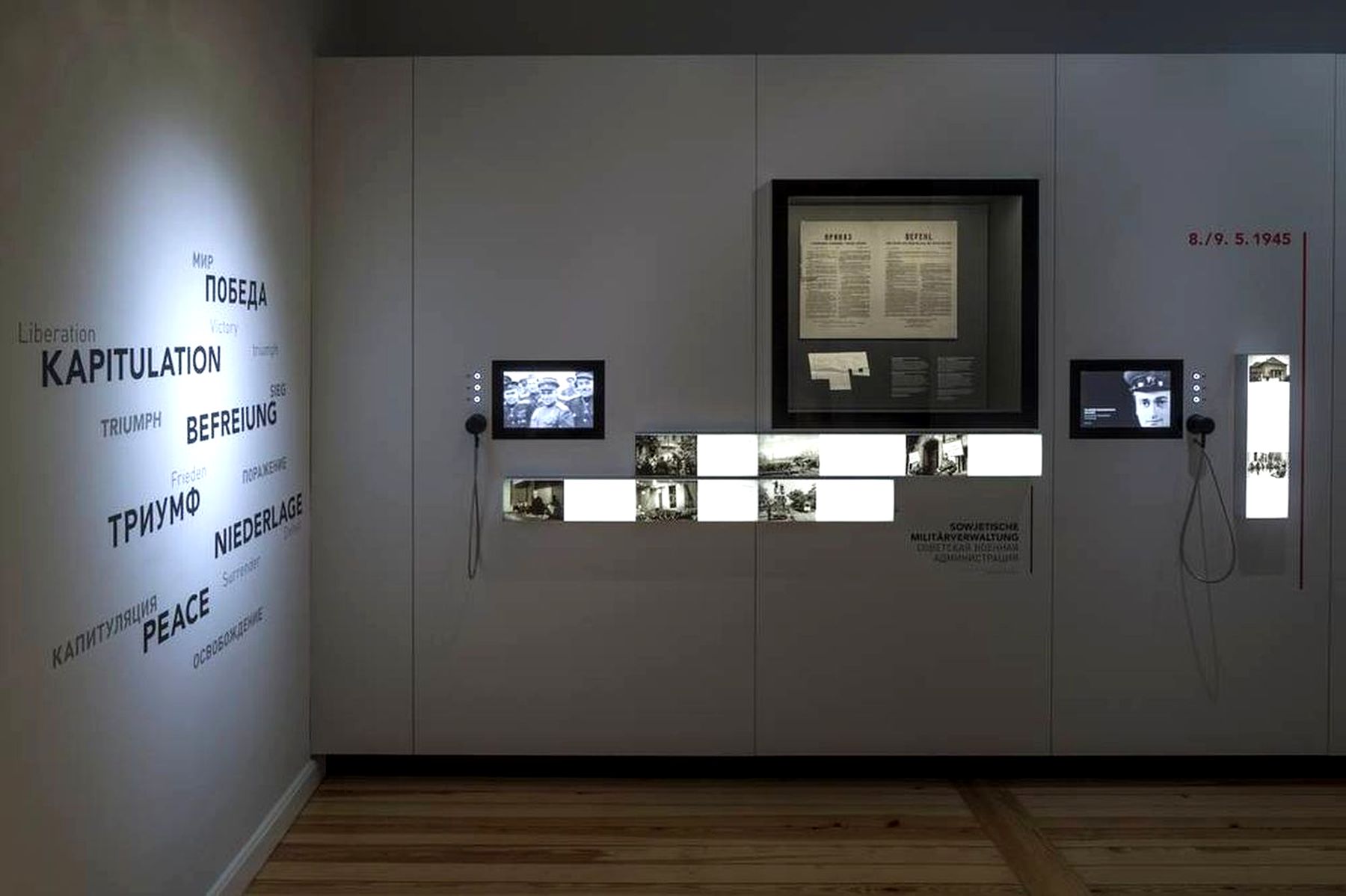
Berlin-Karlshorst "Das Haus in Karlshorst. Geschichte am Ort der
Kapitulation"
Vor 40 Jahren, am 5.
November 1967, wurde im heutigen Deutsch-Russischen Museum das "Museum
der bedingungslosen Kapitulation des faschistischen Deutschland im
Großen Vaterländischen Krieg 1941-1945"
eröffnet. Der Jahrestag ist Anlass, mit einer
Sonderausstellung den Blick auf die Geschichte des Hauses zu werfen.
Unter Einbeziehung der historischen Räumlichkeiten kann der
Besucher die Stationen der Geschichte nachvollziehen, die eng mit der
deutsch-russischen Geschichte, aber auch mit dem Stadtteil Karlshorst
verbunden sind.
Die Exponate stammen
überwiegend aus der Sammlung des Museums. Insbesondere die
Objekte des "Kapitulationsmuseums" sind seit der Schließung
des Museums 1994 nicht mehr gezeigt worden.
1936-1938 als
Offizierskasino der Festungspionierschule erbaut, diente das
Gebäude später als Hauptquartier der 5.
Stoßarmee unter Generaloberst Bersarin. Kurze Zeit war hier
sogar die Berliner Stadtkommandantur untergebracht, bevor am 8. Mai
1945 ein Ereignis von europäischer Bedeutung an diesem Ort
stattfand - die bedingungslose Kapitulation der Wehrmacht und damit das
Ende des Zweiten Weltkrieges in Europa. Nach 1945 hatten die
Sowjetische Militäradministration, die Sowjetische
Kontrollkommission und die Hohe Kommission hier ihren Sitz. Nach Abzug
der ehemals sowjetischen Truppen im Jahre 1994 eröffnete hier
das Deutsch-Russische Museum Berlin-Karlshorst - eine bisher einmalige
bilaterale Einrichtung, die von der Bundesrepublik Deutschland und der
Russischen Föderation getragen wird.
On May 8, 1945, World War
II was brought to an end with the surrender of the German Wehrmacht at
Berlin-Karlshorst. The bloodiest conflict of modern history to date
claimed a death toll of at least 50 million people. The German National
Socialists’ attempt to achieve world domination under the
leadership
of Adolf Hitler ended in widespread destruction in Germany and beyond.
Particularly brutal battles were fought between the German and Soviet
troops as a result of the National Socialist ideology, which aimed to
enslave and ultimately exterminate Slavic peoples.
In 1967, the Soviet troops
stationed in the GDR founded the Museum der bedingungslosen
Kapitulation des faschistischen Deutschland im Großen
Vaterländischen Krieg 1941 - 1945 ("Museum of the
Unconditional Surrender of Fascist Germany in the 'Great Patriotic War'
of 1941 - 1945"). The museum was located in the same building where the
act of surrender was signed in 1945. Initially, the museum
was open only to members of the Soviet Army; however, soon afterwards,
it opened to the general public.
German reunification on October 3, 1990, and the withdrawal of the Soviet troops raised new
questions as to the future of the museum as well as the artifacts it
contained. The Soviets offered to maintain the collection at Karlshorst
and to allow for the continuation of the museum.
On behalf of the Federal
Government of Germany and the "Senate" of Berlin, the German Historical
Museum, in conjunction with their Soviet partners, was given the task
of drawing up a new concept for the continuation of the museum. A
committee of German and Soviet (later Russian) experts, including
political and military historians, archivists and museum specialists,
was appointed for this purpose. The committee began drawing up plans on
April 14, 1991, and by October 1992 they developed a comprehensive
concept for the continuation and reorientation of the Berlin-Karlshorst
museum.
The museum opened its doors
to the public on May 10, 1995.
Ausstellung vom 20. April
bis 8. Juli 2007 Laufzeit: 20.4. -
8.7.2007 PRESSEVORBESICHTIGUNG:
19. April 2007, 11 Uhr
Dr.
Elke Scherstjanoi "Ein Rotarmist in Deutschland" Stern
"Von Siegern und Besiegten" Märkische
Allgemeine "Hinter den Kulissen" Das
Erste "Kulturreport" Berliner
Zeitung "Besatzer, Schöngeist, Nervensäge,
Liebhaber" SR
2
KulturRadio "Deutschland-Tagebuch 1945-1946. Aufzeichnungen
eines Rotarmisten" Die
Zeit "Wodka, Schlendrian, Gewalt" Jüdische
Allgemeine "Aufzeichnungen im Feindesland" Mitteldeutsche
Zeitung "Ein rotes Herz in Uniform" Unveröffentlichte
Kritik "Aufzeichnungen eines Rotarmisten vom Umgang mit den
Deutschen" Bild
"Auf Berlin, das Besiegte, spucke ich!" Das
Buch von
Gregor Thum "Traumland Osten. Deutsche Bilder vom östlichen
Europa im 20. Jahrhundert" Flensborg
Avis "Set med en russisk officers øjne" Ostsee
Zeitung "Das Tagebuch des Rotarmisten" Leipziger
Volkszeitung "Das Glück lächelt uns also
zu!" Passauer
Neue Presse "Erinnerungspolitischer Gezeitenwechsel" Lübecker
Nachrichten "Das Kriegsende aus Sicht eines Rotarmisten" Lausitzer
Rundschau "Ich werde es erzählen" Leipzigs-Neue
"Rotarmisten und Deutsche" SWR2
Radio ART: Hörspiel "Berlin 45" Kulturation
"Tagebuchaufzeichnungen eines jungen Sowjetleutnants" Der
Tagesspiegel "Hier gibt es Mädchen" NDR
"Bücher
Journal" Kulturportal
"Chronik" Sächsische
Zeitung "Bitterer Beigeschmack" Wiesbadener
Tagblatt "Reflexionen, Textcollagen und inhaltlicher Zündstoff" Deutschlandradio
Kultur "Krieg und Kriegsende aus russischer Sicht" Berliner
Zeitung "Die Deutschen tragen alle weisse Armbinden" MDR
"Deutschland-Tagebuch eines Rotarmisten" Jüdisches
Berlin "Das Unvergessliche ist geschehen" / "Личные
воспоминания" Süddeutsche
Zeitung "So dachten die Sieger" Financial
Times Deutschland "Aufzeichnungen aus den
Kellerlöchern" Badisches
Tagblatt "Ehrliches Interesse oder narzisstische Selbstschau?" Freie
Presse "Ein Rotarmist in Berlin" Nordkurier/Usedom
Kurier "Aufzeichnungen eines Rotarmisten ungefiltert" Nordkurier
"Tagebuch, Briefe und Erinnerungen" Ostthüringer
Zeitung "An den Rand geschrieben" Potsdamer
Neueste Nachrichten "Hier gibt es Mädchen" NDR
Info. Forum Zeitgeschichte "Features und Hintergründe" Deutschlandradio
Kultur. Politische Literatur. "Lasse mir eine Dauerwelle
machen" Konkret
"Watching the krauts. Emigranten und internationale Beobachter
schildern ihre Eindrücke aus Nachkriegsdeutschland" Cicero
"Voodoo Child. Die verhexten Kinder" Dagens
Nyheter "Det oaendliga kriget" Utopie-kreativ
"Des jungen Leutnants Deutschland - Tagebuch" Neues
Deutschland "Berlin, Stunde Null" Webwecker-bielefeld
"Aufzeichnungen eines Rotarmisten" Südkurier
"Späte Entschädigung" Online
Rezension "Das kriegsende aus der Sicht eines Soldaten der
Roten Armee" Saarbrücker
Zeitung "Erstmals: Das Tagebuch eines Rotarmisten" Neue
Osnabrücker Zeitung "Weder Brutalbesatzer noch ein
Held" Thüringische
Landeszeitung "Vom Alltag im Land der Besiegten" Das
Argument "Wladimir Gelfand: Deutschland-Tagebuch 1945-1946.
Aufzeichnungen eines Rotarmisten" Deutschland
Archiv: Zeitschrift für das vereinigte Deutschland
"Betrachtungen eines Aussenseiters" Neue
Gesellschaft/Frankfurter Hefte "Von Siegern und Besiegten" Deutsch-Russisches
Museum Berlin-Karlshorst "Deutschland-Tagebuch 1945-1946.
Aufzeichnungen eines Rotarmisten" Online
Rezensionen. Die Literaturdatenbank Literaturkritik
"Ein siegreicher Rotarmist" RBB
Kulturradio "Ein Rotarmist in Berlin" Українська
правда
"Нульовий
варiант" для ветеранiв вiйни / Комсомольская
правда "Нулевой вариант" для ветеранов войны" Dagens
Nyheter. "Sovjetsoldatens dagbok. Hoppfull läsning
trots krigets grymheter" Ersatz
"Tysk dagbok 1945-46 av Vladimir Gelfand" Borås
Tidning
"Vittnesmåil från krigets inferno" Sundsvall
(ST) "Solkig skildring av sovjetisk soldat frеn det besegrade
Berlin" Helsingborgs
Dagblad "Krigsdagbok av privat natur" 2006
Bradfor "Conference on Contemporary German Literature" Spring-2005/2006/2016
Foreign Rights, German Diary 1945-1946 Flamman
/ Ryska Posten
"Dagbok kastar tvivel över våldtäktsmyten" INTERPRES
"DAGBOG REJSER TVIVL OM DEN TYSK-REVANCHISTISKE
“VOLDTÆGTSMYTE” Expressen
"Kamratliga kramar" Expressen
Kultur "Under våldets täckmantel" Lo
Tidningen "Krigets vardag i röda armén" Tuffnet
Radio "Är krigets våldtäkter en
myt?" Norrköpings
Tidningar "En blick från andra sidan" Expressen
Kultur "Den enda vägens historia" Expressen
Kultur "Det totalitära arvet" Allehanda
"Rysk soldatdagbok om den grymma slutstriden" Ryska
Posten "Till försvar för fakta och
anständighet" Hugin
& Munin "En rödarmist i Tyskland" Theater
"Das deutsch-russische Soldatenwörtebuch" / Театр
"Русско-немецкий солдатский разговорник" SWR2
Radio "Journal am Mittag" Berliner
Zeitung "Dem Krieg den Krieg erklären" Die
Tageszeitung "Mach's noch einmal, Iwan!" The
book of
Paul Steege: "Black Market, Cold War: Everyday Life in Berlin,
1946-1949" Телеканал
РТР "Культура"
"Русско-немецкий солдатский разговорник" Аргументы
и факты "Есть ли правда у
войны?" RT
"Russian-German soldier's phrase-book on stage in Moscow" Утро.ru
"Контурная карта великой войны" Коммерсантъ
"Языковой окоп" Телеканал
РТР "Культура": "Широкий
формат с Ириной Лесовой" Museum
Berlin-Karlshorst "Das Haus in Karlshorst. Geschichte am Ort
der Kapitulation" Das
Buch von
Roland Thimme: "Rote Fahnen über Potsdam 1933 - 1989:
Lebenswege und Tagebücher" Das
Buch von Bernd Vogenbeck, Juliane Tomann, Magda Abraham-Diefenbach:
"Terra Transoderana: Zwischen Neumark und Ziemia Lubuska" Das
Buch von
Sven Reichardt
& Malte Zierenberg: "Damals nach dem Krieg Eine Geschichte
Deutschlands - 1945 bis
1949" Lothar
Gall
& Barbara Blessing: "Historische Zeitschrift Register zu Band
276 (2003) bis 285 (2007)" Wyborcza.pl
"Kłopotliwy pomnik w mieście z trudną historią" Kollektives
Gedächtnis "Erinnerungen an meine Cousine Dora aus
Königsberg" Das
Buch von
Ingeborg Jacobs: "Freiwild: Das Schicksal deutscher Frauen 1945" Wyborcza.pl
"Strącona gwiazda wdzięczności" Закон
i
Бiзнес "Двічі по двісті - суд честі" Радио
Свобода
"Красная армия. Встреча с Европой" DEP
"Stupri
sovietici in Germania (1944-45)" Дніпропетровський
національний історичний музей ім. Яворницького "Музей і
відвідувач:
методичні розробки, сценарії, концепції. Листи з 43-го" Explorations
in Russian and Eurasian History "The Intelligentsia Meets the Enemy:
Educated Soviet Officers in Defeated Germany, 1945" DAMALS
"Deutschland-Tagebuch 1945-1946. Gedankenwelt des Siegers" Das
Buch von
Pauline de Bok:
"Blankow oder Das Verlangen nach Heimat" Das
Buch von
Ingo von Münch: "Frau, komm!": die Massenvergewaltigungen
deutscher Frauen und Mädchen 1944/45" Das
Buch von Roland Thimme: "Schwarzmondnacht: Authentische
Tagebücher
berichten (1933-1953). Nazidiktatur - Sowjetische
Besatzerwillkür" История
государства "Миф о миллионах изнасилованных немок" Das
Buch
Alexander Häusser, Gordian Maugg: "Hungerwinter: Deutschlands
humanitäre Katastrophe 1946/47" Heinz
Schilling: "Jahresberichte für deutsche Geschichte: Neue
Folge. 60. Jahrgang 2008" Jan
M.
Piskorski "WYGNAŃCY: Migracje przymusowe i uchodźcy w
dwudziestowiecznej Europie" Wayne
State "The Cultural Memory Of German Victimhood In Post-1990 Popular
German Literature And Television" Deutschlandradio
"Heimat ist dort, wo kein Hass ist" Journal
of Cold War Studies "Wladimir Gelfand, Deutschland-Tagebuch
1945–1946: Aufzeichnungen eines Rotarmisten" ЛЕХАИМ
"Евреи на войне. Солдатские дневники" Частный
Корреспондент "Победа благодаря и вопреки" Перспективы
"Сексуальное насилие в годы Второй мировой войны: память, дискурс,
орудие политики" Радиостанция
Эхо Москвы & RTVi "Не так" с Олегом Будницким: Великая
Отечественная - солдатские дневники" Books
Llc "Person im Zweiten Weltkrieg /Sowjetunion/ Georgi Konstantinowitsch
Schukow, Wladimir Gelfand, Pawel Alexejewitsch Rotmistrow" Das
Buch von
Jan Musekamp: "Zwischen Stettin und Szczecin - Metamorphosen einer
Stadt von 1945 bis 2005" Encyclopedia
of safety "Ladies liberated Europe in the eyes of Russian soldiers and
officers (1944-1945 gg.)" Азовские
греки "Павел Тасиц" Newsland
"СМЯТЕНИЕ ГРОЗНОЙ ОСЕНИ 1941 ГОДА" Wallstein
"Demokratie im Schatten der Gewalt: Geschichten des Privaten im
deutschen Nachkrieg" Вестник
РГГУ
"Болезненная тема второй мировой войны: сексуальное насилие по обе
стороны фронта" Das
Buch von
Jürgen W. Schmidt: "Als die Heimat zur Fremde wurde" ЛЕХАИМ
"Евреи на войне: от советского к еврейскому?" Gedenkstätte/
Museum Seelower Höhen "Die Schlacht" The
book of
Frederick Taylor "Exorcising Hitler: The Occupation and Denazification
of Germany" Огонёк
"10 дневников одной войны" The
book of Michael Jones "Total War: From Stalingrad to Berlin" Das
Buch von Frederick Taylor "Zwischen Krieg und Frieden: Die Besetzung
und Entnazifizierung Deutschlands 1944-1946" WordPress.com
"Wie sind wir Westler alt und überklug - und sind jetzt doch
Schmutz unter ihren Stiefeln" Олег
Будницкий: "Архив еврейской истории" Том 6. "Дневники" Åke
Sandin "Är krigets våldtäkter en myt?" Michael
Jones: "El trasfondo humano de la guerra: con el ejército
soviético de Stalingrado a Berlín" Das
Buch von
Jörg Baberowski: "Verbrannte Erde: Stalins Herrschaft der
Gewalt" Zeitschrift
fur Geschichtswissenschaft "Gewalt im Militar. Die Rote Armee im
Zweiten Weltkrieg" Ersatz-[E-bok]
"Tysk dagbok 1945-46" The
book of Michael David-Fox, Peter Holquist, Alexander M. Martin:
"Fascination and Enmity: Russia and Germany as Entangled Histories,
1914-1945" Елена
Сенявская "Женщины освобождённой Европы глазами советских солдат и
офицеров (1944-1945 гг.)" The
book of
Raphaelle Branche, Fabrice Virgili: "Rape in Wartime (Genders and
Sexualities in History)" (סקירה
צבאית נשים של אירופה המשוחררת דרך עיניהם של חיילים וקצינים סובייטים
(1944-1945 БезФорматаРу
"Хоть бы скорей газетку прочесть" ВЕСТНИК
"Проблемы реадаптации студентов-фронтовиков к учебному процессу после
Великой Отечественной войны" Zeitschrift
für Geschichtswissenschaft 60 (2012), 12 Все
лечится
"10 миллионов изнасилованных немок" Симха
"Еврейский Марк Твен. Так называли Шолома Рабиновича, известного как
Шолом-Алейхем" Nicolas
Bernard "La Guerre germano-soviétique: 1941-1945" (Histoires
d'aujourd'hui) E-Book Annales:
Nathalie Moine "La perte, le don, le butin. Civilisation stalinienne,
aide étrangère et biens trophées dans
l’Union soviétique des années 1940" Das
Buch von Beata Halicka "Polens Wilder Westen. Erzwungene Migration und
die kulturelle Aneignung des Oderraums 1945 - 1948" Das
Buch von
Jan M. Piskorski "Die Verjagten: Flucht und Vertreibung im Europa des
20. Jahrhundert" "آسو
"دشمن هرگز در نمیزن Уроки
истории. ХХ век. Гефтер. "Антисемитизм в СССР во время Второй мировой
войны в
контексте холокоста" Ella
Janatovsky "The Crystallization of National Identity in Times of War:
The Experience of a Soviet Jewish Soldier" Word
War II
Multimedia Database "Borgward Panzerjager At The Reichstag" Militaergeschichtliche
Zeitschrift "Buchbesprechungen" Всеукраинский
еженедельник Украина-Центр "Рукописи не горят" Bücher
/ CD-s / E-Book von Niclas Sennerteg "Nionde arméns
undergång: Kampen om Berlin 1945" Das
Buch von
Michaela Kipp: "Großreinemachen im Osten: Feindbilder in
deutschen Feldpostbriefen im Zweiten Weltkrieg" Петербургская
газета "Женщины на службе в Третьем Рейхе" Володимир
Поліщук "Зроблено в Єлисаветграді" Deutsch-Russisches
Museum Berlin-Karlshorst. Katalog zur Dauerausstellung / Каталог
постоянной экспозиции Clarissa
Schnabel "The life and times of Marta Dietschy-Hillers" Alliance
for Human Research Protection "Breaking the Silence about sexual
violence against women during the Holocaust" Еврейский
музей и центр толерантности. Группа по работе с архивными
документами" Эхо
Москвы
"ЦЕНА ПОБЕДЫ: Военный дневник лейтенанта Владимира Гельфанда" Bok
/ eBok: Anders
Bergman & Emelie Perland "365 dagar: Utdrag ur kända
och
okända dagböcker" РИА
Новости
"Освободители Германии" Das
Buch
von Miriam Gebhardt "Als die Soldaten kamen: Die
Vergewaltigung deutscher Frauen am Ende des Zweiten Weltkriegs" Petra
Tabarelli "Vladimir Gelfand" Das
Buch von
Martin Stein "Die sowjetische Kriegspropaganda 1941 - 1945 in
Ego-Dokumenten" Książka
Beata Halicka "Polski Dziki Zachód. Przymusowe migracje i
kulturowe oswajanie Nadodrza 1945-1948" The
German
Quarterly "Philomela’s Legacy: Rape, the Second World War,
and the Ethics of Reading" MAZ
LOKAL "Archäologische Spuren der Roten Armee in
Brandenburg" Tenona
"Как
фашисты издевались над детьми в концлагере Саласпилс. Чудовищные
исторические факты о концлагерях" Deutsches
Historisches Museum "1945 – Niederlage. Befreiung. Neuanfang.
Zwölf Länder Europas nach dem Zweiten Weltkrieg" День
за днем
"Дневник лейтенанта Гельфанда" BBC
News
"The rape of Berlin" / BBC Mundo / BBC
O`zbek / BBC
Brasil / BBC فارْسِى "تجاوز در برلین" Echo24.cz
"Z
deníku rudoarmějce: Probodneme je skrz genitálie" The
Telegraph "The truth behind The Rape of Berlin" BBC
World
Service "The Rape of Berlin" ParlamentniListy.cz
"Mrzačení, znásilňování, to
všechno
jsme dělali. Český server připomíná
drsné
paměti sovětského vojáka" WordPress.com
"Termina a Batalha de Berlim" Dnevnik.hr
"Podignula je suknju i kazala mi: 'Spavaj sa mnom. Čini što
želiš! Ali samo ti"
ilPOST
"Gli
stupri in Germania, 70 anni fa" 上
海东方报业有限公司
70年前苏军强奸了十万柏林妇女?很多人仍在寻找真相 연
합뉴스 "BBC:
러시아군, 2차대전때 독일에서 대규모 강간" 세계
일보 "러시아군,
2차대전때 독일에서 대규모 강간" Telegraf
"SPOMENIK RUSKOM SILOVATELJU: Nemci bi da preimenuju istorijsko zdanje
u Berlinu?" Múlt-kor "A
berlini asszonyok küzdelme a szovjet erőszaktevők ellen" Noticiasbit.com
"El drama oculto de las violaciones masivas durante la caída
de Berlín" Museumsportal
Berlin "Landsberger Allee 563, 21. April 1945" Caldeirão
Político "70 anos após fim da guerra, estupro
coletivo de
alemãs ainda é episódio pouco
conhecido" Nuestras
Charlas Nocturnas "70 aniversario del fin de la II Guerra Mundial: del
horror nazi al terror rojo en Alemania" W
Radio "El
drama oculto de las violaciones masivas durante la caída de
Berlín" La
Tercera
"BBC: El drama oculto de las violaciones masivas durante la
caída de Berlín" Noticias
de Paraguay "El drama de las alemanas violadas por tropas
soviéticas hacia el final de la Segunda Guerra
Mundial" Cnn
Hit New
"The drama hidden mass rape during the fall of Berlin" Dân
Luận "Trần Lê - Hồng quân, nỗi kinh
hoàng của phụ nữ Berlin 1945" Český
rozhlas "Temná stránka sovětského
vítězství:
znásilňování Němek" Historia
"Cerita Kelam Perempuan Jerman Setelah Nazi Kalah Perang" G'Le
Monde "Nỗi kinh hoàng của phụ nữ Berlin năm 1945 mang
tên Hồng Quân" BBC
News 코리아
"베를린에서 벌어진 대규모 강간" Эхо
Москвы
"Дилетанты. Красная армия в Европе" Der
Freitag
"Eine Schnappschussidee" باز
آفريني
واقعيت ها "تجاوز در برلین" Quadriculado "O
Fim da Guerra e o início do Pesadelo. Duas narrativas sobre
o inferno" Majano
Gossip "PER NON DIMENTICARE... LE PORCHERIE
COMUNISTE!!!" 非
中国日报网
"柏林的强奸" Constantin
Film "Anonyma - Eine Frau in Berlin. Materialien zum Film" Русская
Германия "Я прижал бедную маму к своему сердцу и долго утешал" De
Gruyter Oldenbourg "Erinnerung an Diktatur und Krieg. Brennpunkte des
kulturellen Gedächtnisses zwischen Russland und Deutschland
seit 1945" Memuarist.com
"Гельфанд Владимир Натанович" Πανεπιστημίου
Ιωαννίνων
"Οι νόμοι
του
Πλάτωνα
για την
υβριστική
κακολογία
και την
κατάχρηση
του
δημοσίου" Das
Buch von
Nicholas Stargardt "Der deutsche Krieg: 1939 - 1945"
/ Николас
Старгардт "Мобилизованная нация. Германия 1939–1945" FAKEOFF
"Оглянуться в прошлое" The
book of
Nicholas Stargardt "The German War: A Nation Under Arms,
1939–45" The
book of
Nicholas Stargardt "The German War: A Nation Under Arms,
1939–45" Das
Buch
"Владимир
Гельфанд. Дневник 1941 - 1946" BBC
Русская
служба "Изнасилование Берлина: неизвестная история войны" / BBC Україна
"Зґвалтування Берліна: невідома історія війни" Virtual
Azərbaycan "Berlinin zorlanması" Гефтер.
"Олег Будницкий: «Дневник, приятель дорогой!»
Военный дневник Владимира Гельфанда" Гефтер
"Владимир Гельфанд. Дневник 1942 года" BBC
Tiếng
Việt "Lính Liên Xô 'hãm hiếp
phụ nữ Đức'" Nicolas
Bernard "La Guerre germano-soviétique, 1941-1943" Tome 1 Nicolas
Bernard "La Guerre germano-soviétique, 1943-1945" Tome 2 Эхо
Москвы
"ЦЕНА ПОБЕДЫ: Дневники лейтенанта Гельфанда" Renato
Furtado "Soviéticos estupraram 2 milhões de
mulheres alemãs, durante a Guerra Mundial" Вера
Дубина "«Обыкновенная история» Второй мировой
войны:
дискурсы сексуального насилия над женщинами оккупированных территорий" Еврейский
музей и центр толерантности "Презентация книги Владимира Гельфанда
«Дневник 1941-1946»" Еврейский
музей и центр толерантности "Евреи в Великой Отечественной войне" Сидякин
& Би-Би-Си. Драма в трех действиях. "Атака" Сидякин
& Би-Би-Си. Драма в трех действиях. "Бой" Сидякин
& Би-Би-Си. Драма в трех действиях. "Победа" Сидякин
& Би-Би-Си. Драма в трех действиях. Эпилог Труд
"Покорность и отвага: кто кого?" Издательский
Дом «Новый Взгляд» "Выставка подвига" Katalog
NT "Выставка "Евреи в Великой Отечественной войне " - собрание
уникальных документов" Вести
"Выставка "Евреи в Великой Отечественной войне" - собрание уникальных
документов" Радио
Свобода "Бесценный графоман" Вечерняя
Москва "Еще раз о войне" РИА
Новости "Выставка про евреев во время ВОВ открывается в Еврейском музее" Телеканал
«Культура» Выставка "Евреи в Великой Отечественной
войне"
проходит в Москве Россия
HD "Вести в 20.00" GORSKIE
"В Москве открылась выставка "Евреи в Великой Отечественной войне" Aгентство
еврейских новостей "Евреи – герои войны" STMEGI
TV "Открытие выставки "Евреи в Великой Отечественной войне" Национальный
исследовательский университет Высшая школа экономики "Открытие выставки
"Евреи в Великой Отечественной войне" Независимая
газета "Война Абрама" Revista
de
Historia "El lado oscuro de la victoria aliada en la Segunda Guerra
Mundial" עיתון
סינאתלה גביש הסמל ולדימיר גלפנד מספר על חיי היומיום במלחמה ,
על אורח חיים בחזית ובעורף Лехаим
"Война Абрама" Elhallgatva
"A front emlékezete. A Vörös Hadsereg
kötelékében tömegesen
és
fiatalkorúakon elkövetett nemi erőszak
kérdése a Dél-Vértesben" Libertad
USA "El drama de las alemanas: violadas por tropas
soviéticas en 1945 y violadas por inmigrantes musulmanes en
2016" НГ
Ex Libris
"Пять книг недели" Брестский Курьер "Фамильное
древо Бреста. На перекрестках тех дорог..." Полит.Ру
"ProScience: Олег Будницкий о народной истории войны" Олена
Проскура "Запiзнiла сповiдь" Полит.Ру
"ProScience: Возможна ли научная история Великой Отечественной войны?" Das
Buch
"Владимир Гельфанд. Дневник 1941 - 1946" Ahlul
Bait
Nabi Saw "Kisah Kelam Perempuan Jerman Setelah Nazi Kalah Perang" 北
京北晚新视觉传媒有限公司
"70年前苏军强奸了十万柏林妇女?" Преподавание
истории в школе "«О том, что
происходило…» Дневник Владимира Гельфанда" Вестник
НГПУ
"О
«НЕУБЕДИТЕЛЬНЕЙШЕЙ» ИЗ ПОМЕТ: (Высокая лексика в
толковых словарях русского языка XX-XXI вв.)" Fotografias
da História "Memórias esquecidas: o estupro
coletivo das mulheres alemãs" Archäologisches
Landesmuseum Brandenburg "Zwischen Krieg und Frieden" / "Между войной и
миром" Российская
газета "Там, где кончается война" Народный
Корреспондент
"Женщины освобождённой Европы глазами советских солдат: правда про "2
миллиона изнасилованых немок" Fiona
"Военные изнасилования — преступления против жизни и личности" 军
情观察室
"苏军攻克柏林后暴行妇女遭殃,战争中的强奸现象为什么频发?" Независимая
газета "Дневник минометчика" Независимая
газета "ИСПОДЛОБЬЯ: Кризис концепции" East
European Jewish Affairs "Jewish response to the non-Jewish question:
“Where were the Jews during the fighting?”
1941–5" Niels
Bo
Poulsen "Skæbnekamp: Den tysk-sovjetiske krig 1941-1945" Olhar
Atual
"A Esquerda a história e o estupro" The
book of Stefan-Ludwig Hoffmann, Sandrine Kott, Peter Romijn, Olivier
Wieviorka "Seeking Peace in the Wake of War: Europe, 1943-1947" Walter
de
Gruyter "Germans into Allies: Writing a Diary in 1945" Blog
in Berlin "22. Juni – da war doch was?" Steemit
"Berlin Rape: The Hidden History of War" Estudo
Prático "Crimes de estupro na Segunda Guerra Mundial e
dentro do exército americano" Громадське
радіо "Насильство над жінками під час бойових дій — табу для
України" InfoRadio
RBB "Geschichte in den Wäldern Brandenburgs" "شگفتی
های
تاریخ است "پشت پرده تجاوز به زنان برلینی در پایان جنگ جهانی دوم Hans-Jürgen
Beier gewidmet "Lehren – Sammeln – Publizieren" The
book of
Miriam Gebhardt "Crimes Unspoken: The Rape of German Women at the End
of the Second World War" Русский
вестник "Искажение истории: «Изнасилованная
Германия»" 凯
迪
"推荐《柏林女人》与《五月四日》影片" Vix
"Estupro
de guerra: o que acontece com mulheres em zonas de conflito, como
Aleppo?" Universidad
del Bío-Bío "CRÍMENES DE GUERRA RUSOS
EN LA SEGUNDA GUERRA MUNDIAL (1940-1945)" "المنصة
"العنف ضد المرأة.. المسكوت عنه في الحرب العالمية الثانية Книга.
Олег
Шеин "От Астраханского кремля до Рейхсканцелярии. Боевой путь 248-й
стрелковой дивизии" Cambridge
University Press "Of Loss and Loot: Stalin-Era Culture, Foreign Aid,
and Trophy Goods in the Soviet Union during the 1940s" Sodaz
Ot
"Освободительная миссия Красной Армии и кривое зеркало вражеской
пропаганды" Sodaz
Ot
"Советский воин — освободитель Европы: психология и поведение
на завершающем этапе войны" 企
业头条
"柏林战役后的女人" Sántha
István "A front emlékezete" 腾
讯公司 "二战时期欧洲, 战胜国对战败国的十万妇女是怎么处理的!" El
Nuevo
Accion "QUE LE PREGUNTEN A LAS ALEMANAS VIOLADAS POR RUSOS,
NORTEAMERICANOS, INGLESES Y FRANCESES" Periodismo
Libre "QUE LE PREGUNTEN A LAS ALEMANAS VIOLADAS POR RUSOS,
NORTEAMERICANOS, INGLESES Y FRANCESES" DE
Y.OBIDIN
"Какими видели европейских женщин советские солдаты и офицеры
(1944-1945 годы)?" Magyar
Tudományos Akadémia
"Váltóállítás:
Diktatúrák a vidéki
Magyarországon 1945-ben" 歷
史錄
"近1萬女性被強姦致死,女孩撩開裙子說:不下20個男人戳我這兒" Cyberpedia
"Проблема возмездия и «границы ненависти» у
советского солдата-освободителя" NewConcepts
Society "Можно ли ставить знак равенства между зверствами гитлеровцев и
зверствами советских солдат?" 搜
狐
"二战时期欧洲,战胜国对战败国的妇女是怎么处理的" Ranker
"14
Shocking Atrocities Committed By 20th Century Communist Dictatorships" Эхо
Москвы
"Дилетанты. Начало войны. Личные источники" Журнал
"Огонёк" "Эго прошедшей войны" 이
창남 외 공저
"폭력과 소통 :트랜스내셔널한 정의를 위하여" Уроки
истории. XX век "Книжный дайджест «Уроков истории»:
советский антисемитизм" Свободная
Пресса "Кто кого насиловал в Германии" EPrints
"Взаємовідносини червоноармійців з цивільним населенням під час
перебування радянських військ на території Польщі (кінець 1944 -
початок 1945 рр.)" Pikabu
"Обратная сторона медали" Озёрск.Ru "Война и немцы" Імекс-ЛТД
"Історичний календар Кіровоградщини на 2018 рік. Люди. Події. Факти" יד
ושם -
רשות הזיכרון לשואה ולגבורה "Vladimir Gelfand" Atchuup!
"Soviet soldiers openly sexually harass German woman in Leipzig after
WWII victory, 1945" Книга
Мириам
Гебхардт "Когда пришли солдаты. Изнасилование немецких женщин в конце
Второй мировой войны" Coffe
Time
"Женщины освобождённой" Дилетант
"Цена победы. Военный дневник лейтенанта Владимира Гельфанда" Feldgrau.Info
- Bоенная история "Подборка" Вечерний
Брест "В поисках утраченного времени. Солдат Победы Аркадий Бляхер.
Часть 9. Нелюбовь" Геннадий
Красухин "Круглый год с литературой. Квартал четвёртый" Аргументы
недели "Всю правду знает только народ. Почему фронтовые дневники совсем
не похожи на кино о войне" Fanfics.me
"Вспомним подвиги ветеранов!" VietInfo
"Hồng quân, Nỗi kinh hoàng của phụ nữ Berlin năm
1945" Книга:
Виталий Дымарский, Владимир Рыжков "Лица войны" Birthe
Kundrus "Dieser Krieg ist der große Rassenkrieg": Krieg und
Holocaust in Europa Dozor
"Про
День Перемоги
в Кіровограді, фейкових ветеранів і "липове" примирення" East
European Jewish Affairs "Review of Dnevnik 1941-1946, by Vladimir
Gel’fand" The
book of
Harriet Murav, Gennady Estraikh "Soviet Jews in World War II: Fighting,
Witnessing, Remembering" TARINGA!
"Las violaciones masivas durante la caída de
Berlín" ВолиньPost
"Еротика та війна: спогади про Любомль 1944 року" Anews
"Молодые воспринимают войну в конфетном обличии" RTVi
"«Война эта будет дикая». Что писали 22 июня 1941
года в дневниках" Tribun
Manado "Nasib Kelam Perempuan Jerman Usai Nazi Kalah, Gadis Muda,
Wanita Tua dan Hamil Diperkosa Bergantian" The
book of
Elisabeth Krimmer "German Women's Life Writing and the Holocaust:
Complicity and Gender in the Second World War" ViewsBros
"WARTIME VIOLENCE AGAINST WOMEN" Xosé
Manuel Núñez Seixas "El frente del Este :
historia y memoria de la guerra germano-soviética, 1941-1945" اخبار
المقطم
و الخليفه " إغتصاب برلين الكبير" Русская
семерка "В чьем плену хуже всего содержались женщины-военные на Второй
мировой" Nicholas
Stargardt "La guerra tedesca. Una nazione sotto le armi 1939-1945" Mail
Online "Mass grave containing 1,800 German soldiers who perished at the
Battle of Stalingrad is uncovered in Russia - 75 years after WWII's
largest confrontation claimed 2 mln lives" PT.
Kompas
Cyber Media "Kuburan Massal 1.800 Tentara Jerman Ditemukan di Kota
Volgograd" Công
ty Cổ phần Quảng cáo Trực tuyến 24H "Nga: Sửa ống nước,
phát hiện 1.800 hài cốt của trận đánh
đẫm máu nhất lịch sử" LGMI
News
"Pasang Pipa Air, Tukang Temukan Kuburan Masal 1.837 Tentara Jerman" Quora
"¿Cuál es un hecho sobre la Segunda Guerra
Mundial que la mayoría de
las personas no saben y probablemente no quieren saber?" "مجله
مهاجرت "آنچه روسها در برلین انجام دادند! Музейний
простiр "Музей на Дніпрі отримав новорічні подарунки під
ялинку" Bella
Gelfand. Wie in Berlin Frau eines Rotarmisten Wladimir Gelfand
getötet wurde ..
.. The
book of
Paul Roland "Life After the Third Reich: The Struggle to Rise from the
Nazi Ruins" O
Sentinela "Dois Milhões de Alemãs: O Maior
Estupro em
Massa da História foi um Crime Aliado-Soviético" Stratejik
Güvenlik "SAVAŞ DOSYASI : TARİHTEN BİR KARE – 2.
DÜNYA SAVAŞI BİTİMİNDE ALMANYA’DA KADINLARA TOPLU
TECAVÜZLER" Агентство
новостей «Хакасия-Информ» "Кто остановит шоу
Коновалова?" Isralike.org
"Цена победы. Военный дневник лейтенанта Владимира Гельфанда" Robert
Dale “For what and for whom were we fighting?”: Red
Army Soldiers,
Combat Motivation and Survival Strategies on the Eastern Front in the
Second World War "طرفداری
"پایان رویای نازیسم / سقوط امپراطوری آدولف هیتلر Das
Buch von
Kerstin Bischl "Frontbeziehungen: Geschlechterverhältnisse und
Gewaltdynamiken in der Roten Armee 1941-1945" Русская
семерка "Красноармейцы или солдаты союзников: кто вызывал у немок
больший страх" Kibalchish
"Фрагменты дневников поэта-фронтовика В. Н. Гельфанда" History
Magazine
"Sõjapäevik leitnant Vladimir Gelfand" Magazine
online "Vojnový denník poručíka
Vladimíra Gelfanda" theБабель
"Український лейтенант Володимир Гельфанд пройшов Другу світову війну
від Сталінграда до Берліна" Znaj.UA
"Жорстокі знущання та масові вбивства: злочини Другої світової показали
в моторошних кадрах" Gazeta.ua
"Масові вбивства і зґвалтування: жорстокі злочини Другої світової війни
у фотографіях" PikTag
"Знали вы о том,
что советские солдаты ИЗНАСИЛОВАЛИ бессчетное число женщин по пути к
Берлину?" Kerstin
Bischl "Sammelrezension: Alltagserfahrungen von Rotarmisten
und ihr Verhältnis zum Staat" Конт "Несколько слов о
фронтовом дневнике" Livejournal
"Уникальный дневник солдата Сталина" Sherstinka
"Német megszállók és nők.
Trófeák
Németországból - mi volt és
hogyan" Олег
Сдвижков "Красная Армия в Европе. По страницам дневника Захара
Аграненко" X-True.Info
"«Русские варвары» и «цивилизованные
англосаксы»: кто был более гуманным с немками в 1945 году" Veröffentlichungen
zur brandenburgischen Landesarchäologie "Zwischen Krieg und
und Frieden: Waldlager der Roten Armee 1945" Sherstinka
"Szovjet lányok megerőszakolása a
németek által a megszállás
alatt. Német fogságba esett nők" Dünya
Haqqinda "Berlin zorlanmasi: İkinci Dünya Müharibəsi" Dioxland
"NEMŠKIM VOJAKOM JE BILO ŽAL RUSKIH ŽENSK. VSE KNJIGE SO O:
"VOJAŠKIH SPOMINIH NEMŠKEGA..." Actionvideo
"Gewalt gegen deutsche Frauen durch Soldaten der Roten Armee.
Entsetzliche Folter und Hinrichtungen durch japanische Faschisten
während des Zweiten Weltkriegs!" Maktime
"Was machten die Nazis mit den gefangenen sowjetischen
Mädchen? Wer hat
deutsche Frauen vergewaltigt und wie sie im besetzten Deutschland
gelebt haben" Музей
«Пам’ять єврейського народу та Голокост в
Україні» отримав у дар унікальні експонати Sherstinka
"Что творили с пленными женщинами фашисты. Жестокие пытки женщин
фашистами" Bidinvest
"Brutalitäten der Sowjetarmee - Über die
Gräueltaten der sowjetischen
"Befreier" in Europa. Was haben deutsche Soldaten mit russischen Frauen
gemacht?" Русский
сборник XXVII "Советские потребительские практики в
«маленьком СССР», 1945-1949" Academic
Studies Press. Oleg Budnitskii: "Jews at War: Diaries from the Front" Gazeta
Chojeńska "Wojna to straszna trauma, a nie fajna przygoda" Historiadel.net
"Crímenes de violación de la Segunda Guerra
Mundial y el Ejército de EE. UU." 화
요지식살롱
"2차세계대전 말, 소련에게 베를린을 점령당한 '독일 여자들'이 당한 치욕의 역사" The
Global
Domain News "As the soldiers did to captured German women" Quora
"Você sabe de algum fato da Segunda Guerra Mundial que a
maioria das
pessoas não conhece e que, provavelmente, não
querem saber?" MOZ.de
"Als
der Krieg an die Oder kam – Flucht aus der Festung Frankfurt" Музей
"Пам'ять єврейського народу та Голокост в Україні". "1 березня 1923 р.
– народився Володимир Гельфанд" Wyborcza.pl
"Ryk gwałconych kobiet idzie przez pokolenia. Mało kto się nim
przejmuje" Cноб
"Женщина — военный трофей. Польский историк о изнасилованиях
в Европе во время Второй мировой" Refugo
"O
estupro da Alemanha" Historia
National Geographic "la batalla de berlín durante la segunda
guerra mundial" Politeka
"Росіянам напередодні 9 травня нагадали про злочини в Німеччині:
«Заплямували себе...»" Акценты
"Советский офицер раскрыл тайны Второй мировой: рассказал без прикрас" БелПресса
"Цена Победы. Какой была военная экономика" Lucidez
"75
años de la rendición nazi: Los matices del
“heroísmo” soviético" UM
CANCERIANO SEM LAR "8 de Maio de 1945" Lasteles.com
"La Caída de la Alemania Nazi: aniversario de la
rendición de Berlin" Cloud
Mind
"Violence Against Women: The Rape Of Berlin WW2" Музей
"Пам'ять єврейського народу та Голокост в Україні" "8 ТРАВНЯ
– ДЕНЬ ПАМ’ЯТІ І ПРИМИРЕННЯ" Lunaturaoficial
"LIBROS QUE NO HICIERON HISTORIA: EL DIARIO DE LOS HORRORES" CUERVOPRESS
"El drama oculto de las violaciones masivas durante la caída
de Berlín" EU
Today
"The Rape of Berlin: Red Army atrocities in 1945" Издательство
Яндекс + История будущего "Настоящий 1945" Вне
строк
"Похищение Берлина: зверства Красной армии в 1945 году" Frankfurter
Allgemeine Zeitung "Erlebt Russland eine neue Archivrevolution?" The
book of Beata Halicka "The Polish Wild West: Forced Migration and
Cultural Appropriation in the Polish-german Borderlands, 1945-1948" Twentieth-Century
Literature “A World of Tomorrow”: Trauma, Urbicide,
and Documentation
in A Woman in Berlin: Eight Weeks in the Conquered City Märkische
Onlinezeitung "Sowjetische Spuren in Brandenburgs Wäldern" Revue
Belge de Philologie et d’Histoire "Soviet Diaries of the
Great Patriotic War" Der
Spiegel
"Rotarmisten und deutsche Frauen: "Ich gehe nur mit
anständigen Russen" ReadSector
"Mass grave of WWII Nazi paratroopers found in Poland contains 18
skeletons and tools with swastikas" ИноСМИ
"Der
Spiegel (Германия): «Я гуляю только с порядочными
русскими" Actionvideo
"Jak naziści szydzili z rosyjskich kobiet. Gwałt w Berlinie: nieznana
historia wojny" Вера
Дубина
"Сексуальное насилие в памяти о Второй мировой войне" Graf
Orlov
33 "ДНЕВНИК В. ГЕЛЬФАНДА советского офицера РККА" Deutsche
Welle
"Послевоенная Германия в дневниках и фотографиях" Deutsche
Welle "За что немки любили в 1945 году лейтенанта Красной
армии?" Elke
Scherstjanoi "Sieger leben in Deutschland: Fragmente einer
ungeübten
Rückschau. Zum Alltag sowjetischer Besatzer in Ostdeutschland
1945-1949" SHR32
"Rus əsgərləri alman qadınlarına necə istehza etdilər. Alman
qadınlarını kim zorlayıb və onlar işğal olunmuş Almaniyada necə
yaşayıblar" Детектор
медіа "«Гра тіней»: є сенс продовжувати далі" Historia
provinciae "Повседневная жизнь победителей в советской зоне оккупации
Германии в воспоминаниях участников событий" Portal
de Prefeitura
"Artigo: “FRAU, KOMM!” O maior estupro coletivo da
história" Pikabu
"Извращение или традиция, потерявшая смысл?" Русская
Семерка "Владимир Гельфанд: от каких слов отказался
«отец» мифа об изнасиловании немок советскими
солдатами" Институт
российской истории РАН "Вторая мировая и Великая Отечественная: к
75-летию окончания" Kozak
UA "Як
"діди" німкень паплюжили в 1945 році" Dandm
"Cómo los nazis se burlaron de las mujeres rusas. Mujeres
rusas violadas y asesinadas por los alemanes" Permnew.Ru
"«Диван» Федора Вострикова. Литобъединение" Neurologystatus
"Violence women in the Second World War. Shoot vagas: why soldiers rape
women" Brunilda
Ternova "Mass rapes by Soviet troops in Germany at the end of World War
II" The
book
Stewart Binns "Barbarossa: And the Bloodiest War in History" Reddit
"Did
the Soviet Army really raped 2 million women during WW2? Are the
numbers correct?" Книга.
Новое
литературное обозрение: Будницкий Олег "Люди на войне" Леонід
Мацієвський "9 травня – День перемоги над здоровим глуздом.
Про згвалтовану Європу та Берлін" Полит.Ру
"Люди на войне" #CОЦИАЛЬНАЯ
ИСТОРИЯ #ПАМЯТЬ "Владимир Гельфанд: месяц в послевоенном Берлине" Новое
литературное обозрение "Ирина Прохорова, Олег Будницкий, Иван Толстой:
Люди на войне" JoyReactor
"Зверства советских солдат во время Великой Отечественной войны" Georgetown
University "Explorations in Russian and Eurasian History": "Emotions
and Psychological Survival in the Red Army, 1941–42" Forum24
"Co
se dělo se zajatými rudoarmějkami? Jaký byl osud
zajatých žen z Wehrmachtu?" Quora,
Inc.
"Which was the cruelest army in WW2 and WW1?" Радио
Свобода "Война и народная память" Лехаим
"Двадцать второго июня..." Русская
семёрка "Как изменилось отношение немок к красноармейцам в 1945 году" Исторический
курьер "Героизм, герои и награды: «героическая сторона»
Великой Отечественной войны в воспоминаниях современников" Коммерсантъ
"Фронт и афронты" Русская
семёрка "Владимир Гельфанд: что не так в дневниках автора мифа об
«изнасилованной» Германии" Medium
"The Brutal Rapes of Every German Female from Eight to Eighty" One News Box
"How German women suffered largest mass rape in history by foreign
solders" نیمرخ
"نقش زنان در جنگها - قسمت اول: زنان به مثابه قربانی جنگ" Bolcheknig
"Що німці робили з жінками. Уривок з щоденника дівчини, яку німці
використовували як безкоштовну робочу силу. Життя в таборі" Nrgaudit
"Рассказы немецких солдат о войне с русскими. Мнения немцев о русских
солдатах во время Второй мировой войны" Музей
"Пам'ять єврейського народу та Голокост в Україні "На звороті знайомого
фото" Новое
литературное обозрение. Книга: Козлов, Козлова "«Маленький
СССР» и его обитатели. Очерки социальной истории советского
оккупационного сообщества" Sattarov
"Mga babaeng sundalo sa pagkabihag ng Aleman. Kabanata limang mula sa
librong "Pagkabihag. Ito ang ginawa ng mga Nazi sa mga nahuling
kababaihan ng Soviet" Política
Obrera "Sobre “José Pablo Feinmann y la
violación en manada" Эхо
Москвы "Цена победы. Люди на войне" SHR32
"How Russian soldiers mocked German women. Trophies from Germany - what
it was and how. Who raped German women and how they lived in occupied
Germany" Олег
Сдвижков: "«Советских порядков не вводить!» Красная армия
в Европе 1944—1945 гг." Livejournal
"Чья бы мычала" Newton
Compton Editori. Stewart Binns "Operazione Barbarossa. Come Hitler ha
perso la Seconda guerra mondiale" Kingvape
"Rosa Kuleshovs Belichtung. Rosa Kuleshov ist die mysteriöseste
Hellseherin der Sowjetzeit. Zwischen rot und grün" Kfdvgtu
الجوائز من ألمانيا - ما كان عليه وكيف. الذين اغتصبوا الألمانية وكيف عاش
في ألمانيا المحتلة nc1
"Αναμνήσεις
στρατιωτών
πρώτης γραμμής
για
Γερμανίδες.
Οι απόψεις
των Γερμανών
για τους
Ρώσους
στρατιώτες
κατά τον Β'
Παγκόσμιο
Πόλεμο" ik-ptz
"Was haben deutsche Soldaten mit russischen Mädchen gemacht? Das
haben die Nazis mit gefangenen sowjetischen Frauen gemacht" مراجعة
عسكرية نساء أوروبا المحررات من خلال عيون الجنود
والضباط السوفيت (1944-1945) nc1
"Scrisori de soldați ruși despre germani. Cum au șocat femeile
sovietice pe ocupanții germani" 中
新健康娱乐网
"柏林战役德国女人 70年前苏军强奸了十万柏林妇女?" پورتال
برای دانش آموز. خودآموزی، "نازی ها با زنان اسیر چه کردند؟
نحوه آزار نازی ها از کودکان در اردوگاه کار اجباری سالاسپیلس" Русская
Семерка "Каких штрафников в Красной Армии называли
«эсэсовцами»" Голос
Народу "Саша Корпанюк: Кто и кого изнасиловал в Германии?" Gorskie
"Новые источники по истории Второй мировой войны: дневники" TransQafqaz.com
"Fedai.az Araşdırma Qrupu" Ik-ptz
"What did the Nazis do with the captured women. How the Nazis abused
children in the Salaspils concentration camp" Евгений
Матонин "22 июня 1941 года. День, когда обрушился мир" Ulisse
Online "Per non dimenticare: orrori contro i bambini" Наука.
Общество. Оборона "«Изнасилованная Германия»: из
истории современных ментальных войн" Quora
"Por que muitos soldados estupram mulheres durante guerras?" Stefan
Creuzberger "Das deutsch-russische Jahrhundert: Geschichte einer
besonderen Beziehung" პორტალი
სტუდენტისთვის "როგორ დასცინოდნენ რუსი ჯარისკაცები გერმანელებს" Зеркало
"Где
и когда русское воинство ЧЕСТЬ потеряло?" WordPress.com
Historywithatwist "How Russia has used rape as a weapon of war" Mai
Khôi Info "Lính Liên Xô
'hãm hiếp phụ nữ Đức'" EU
Political Report "Russia is a Country of Marauders and Murderers" بالاترین
"روایت ستوان روس «ولادیمیر گلفاند» از
«تجاوز جنسی» وحشیانهی ارتش سرخ شوروی به
«زنان آلمانی»/عکس" TCH
"Можемо
повторити": як радянські солдати по-звірячому і безкарно ґвалтували
німецьких жінок 인사이트
"2차 세계
대전 때에도 독일 점령한 뒤 여성 200만명 성폭행했던 러시아군" Robert
Lansing Institute "War crimes to reflect the essence of Russians" Pravda.Ru
"Fake news about fake rapes in Ukraine to ruin Russian solder's image" Alexey
Tikhomirov "The Stalin Cult in East Germany and the Making of the
Postwar Soviet Empire, 1945-1961" Дилетант
"Олег Будницкий / Человек на фоне эпох / Книжное казино. Истории" The
Sault Star "OPINION: Suffering of children an especially ugly element
of war" El
Español "Por qué la Brutalidad del
Ejército Ruso se Parece más a una Novela de
Stephen King que de Orwell" Ratnik.tv
"Одесса. Еврейский вопрос. Дорогами смерти" Алексей
Митрофанов "Коммунальная квартира" Militaergeschichtliche
Zeitschrift "Evakuierungs- und Kriegsschauplatz Mark Brandenburg" Raovatmaytinh
"Phim cấp 3 tội ác tra tấn tình dục và
hiếp dâm của phát xít đức phần 1" Apollo.lv
"Kā Otrais pasaules karš noslēdzās ar PSRS armijas veiktu
masveida izvarošanas kampaņu Vācijā" Как
ў Беларусі "Who raped whom in Germany" / "Кто кого насиловал в Германии" Konkretyka
"Діди-ґвалтівники, або міф про
«воїнів-освободітєлєй»" LinkedIn
"Grandfathers-rapists, or the myth of "warriors-liberators". Typical
Russian imperial character" Danielleranucci
"Lit in the Time of War: Gelfand, Márquez, and Ung" Смоленская
газета "Истинная правда и её фальшивые интерпретации" Дзен
"Я влюбился в портрет Богоматери..." Из фронтовых дневников лейтенанта
Владимира Гельфанда Дзен
"Праздник Победы отчасти горек для меня..." Зарубежные впечатления
офицера Красной армии Гельфанда UkrLineInfo
"Жiноча смикалка: способи самозахисту від сексуального насилля в роки
Другої світової війни" Memo
Club.
Владимир Червинский: "Одесские истории без хэппи энда" Thomas
Kersting, Christoph Meißner, Elke Scherstjanoi "Die Waldlager
der Roten Armee 1945/46: Archäologie und Geschichte" Jean
Lopez,
Lasha Otkhmezuri "Barbarossa - 1941: La guerre absolue" Дилетант
"Дневники военного времени" Goldenfront
"Самосуд над полицаями в Одессе в 1944 году: что это было" Gedenkstätten
Buchenwald "Nach dem Krieg. Spuren der sowjetischen Besatzungszeit in
Weimar 1945-50: Ein Stadtrundgang" Historia
National Geographic "la segunda guerra mundial al completo, historia
del conflicto que cambió el mundo" સ્વર્ગારોહણ
"કેવી રીતે રશિયન સૈનિકોએ જર્મન લોકોની મજાક ઉડાવી" Absorbwell
"Causas Y Consecuencias De La Segunda Guerra Mundial Resumen" לחימה
יהודית א. יהודים בצבא האדום Український
світ "«Можем повторіть» — про звірства
російських солдат під час Другої світової війни" Oleg
Budnitskii, David Engel, Gennady Estraikh, Anna Shternshis: "Jews in
the Soviet Union: A History: War, Conquest, and Catastrophe,
1939–1945" Andrii
Portnov "Dnipro: An Entangled History of a European City" Татьяна
Шишкова "Внеждановщина. Советская послевоенная политика в области
культуры как диалог с воображаемым Западом" The
Chilean
"Roto". "VIOLADA" Дзен
"Немок
сажайте на мохнатые мотороллеры". Что сделали с пленными немками в
Советском Союзе" ProNews
"Σιλεσία
1945: Με
εθνοκάθαρση
η πρώτη
τιμωρία
των
Γερμανών
για τα
εγκλήματα
τους
στο Β΄ ΠΠ" Livejournal
"Одесситы - единственные в СССР - устроили самосуд в 1944 году" Scribd
"Estupro em Massa de Alemãs" Музей
«Пам’ять єврейського народу та Голокост в
Україні» ЦЬОГО ДНЯ – 100-РІЧЧЯ ВІД ДНЯ НАРОДЖЕННЯ
ВОЛОДИМИРА ГЕЛЬФАНДА Davidzon
Radio "Владимир Гельфанд. Шокирующий дневник войны". Валерия Коренная в
программе "Крылья с чердака" Імекс
ЛТД "Історичний календар Кіровоградщини 2023 рік. Люди. Події. Факти" Quora
"Open to the weather, lacking even primitive sanitary facilities,
underfed, the prisoners soon began dying of starvation and disease" Infobae
"El
calvario de las mujeres tras la caída de Berlín:
violaciones masivas del Ejército Rojo y ola de suicidios" Научная
электронная библиотека "Военные и блокадные дневники в издательском
репертуаре современной России (1941–1945)" Historywithatwist
"How Russia has used rape as a weapon of war" Інститут
історії України "Романтичні стосунки дівчат і жінок із солдатами
ворожих армій у роки німецько-радянської війни" Я
"Масові
зґвалтування радянськими військовими німецьких жінок в Берліні під час
Другої світової війни" Periodista
Digital "Las terribles violaciones ocultas tras la caída de
Berlín" Tạp
chí Nước Đức "Hồng quân Liên
Xô, nỗi kinh hoàng của phụ nữ Berlin năm 1945" زیتون |
سایت خبری تحلیلی زیتون "بدن زن؛ سرزمینی که باید فتح شود!" Enciclopedia
Kiddle Español "Evacuación de Prusia Oriental
para niños" Ukraine
History "Діди-ґвалтівники, або міф про
«воїнів-визволителів». Типовий російський
імперський характер" LWL
Landesmuseum Herne "Sterne im Wald - Soldaten der Roten Armee zwischen
Krieg und Frieden 1945" Локальна
Історiя "Жаске дежавю: досвід зустрічі з "визволителями" Tamás
Kende "Class War or Race War The Inner Fronts of Soviet Society during
and after the Second World War" museum-digital
berlin "Vladimir Natanovič Gel'fand" 니콜
라스 스타가르트 저
"독일인의 전쟁 1939-1945" 知乎
"苏联红军在二战中的邪恶暴行" Вестник
Омского Университета "ВЕЛИКАЯ ОТЕЧЕСТВЕННАЯ ВОЙНА В ЧЕЛОВЕЧЕСКОМ
ИЗМЕРЕНИИ" Mast.al
"Silesia 1945: Spastrimin Etnik, Dënimi i Parë i
Gjermanëve për Krimet e Tyre në L2B" Quora
"History of World War 2 and its aftermath" Засновано
на реальних подіях: "Ґвалтували КОЖНУ від 8 до 80..!" -
свідчення "подвигів" червоноармійців у Німеччині, Польщі та СРСР Teletype
"И три дня на разграбление…" Еврейский
музей и центр толерантности "По следам дневников Гельфанда" Jornal
de Psicanálise "Homens homenageados usurpam os corpos de
mulheres violadas, e a guerra não tem rosto de mulher: apenas
corpos" Brandenburgikon
"Waldlager der Roten Armee" Bertrada.uno
"Apa yang Terjadi pada Mayat-mayat di Pertempuran Berlin?" /
Grunge "What Happened To The Bodies At The Battle Of Berlin?" Сноб
Медиа «Истоки советской фотографии» в Еврейском
музее Das
Buch von Volker Heise "1945" Regioactive
"Anonyma (i. e. Marta Hillers) und Wladimir N. Gelfand.
Doppelporträts und exemplarische Texte" United24
Media "Sexual Violence as a Tool Of Russian Warfare, From World War II
to Today in Ukraine" Музей
"Пам'ять єврейського народу та Голокост в Україні": "Мрія бути
письменником" Еврейская
община Днепра "Єврейський Музей уперше опублікував уривки зі
знаменитого щоденника Володимира Гельфанда" خبرفوری
"رازهای مگوی جنگ جهانی دوم؛ ماجرای تجاوز ارتش سرخ شوروی به زنان آلمانی
چه بود؟ / از سربازان پیر تا همسایگان خاموش" Medium
"80 Years After World War II: Love and Hatred in the Ruins —
Vladimir Gelfand’s Diaries as a Mirror of Soviet Memory" Hit
Radio FFH "Was bisher geschah. Kriegsende 1945. Hitlers letzte
Offensive" Jewish
"В Еврейском музее откроется выставка в честь 80-летия Победы" Museum
Berlin-Karlshorst "LA CAPITULATION ALLEMANDE DE MAI 1945" / "KAPITULACJA
NIEMIECKA W MAJU 1945 R." Will
und Roswitha Quadflieg »Ich will lieber schweigen«:
Das Tagebuch eines Schauspielers aus den Jahren 1945/46 und die Fragen
seiner Tochter Storica
National Geographic "La Seconda Guerra Mondiale nella sua interezza:
storia di un conflitto che ha cambiato il mondo" Deutsche
Welle "2 de maio de 1945: a queda da Berlim nazista" Museum
Berlin-Karlshorst "DIE DEUTSCHE KAPITULATION IM MAI 1945" Ukraine
History "Діди-ґвалтівники, або міф про
«воїнів-визволителів». Типовий російський
імперський характер" Copernico
"Völkerwanderung. Der Schauplatz Reetz (Neumark) 1945" Museum
Berlin-Karlshorst "КАПІТУЛЯЦІЯ НІМЕЧЧИНИ У ТРАВНІ 1945 РОКУ" /
"THE GERMAN
SURRENDER IN MAY 1945" lenta.ru
«Улыбаясь и плача, обнимаются и целуются все подряд»
Великая Победа в воспоминаниях очевидцев. Как мир встретил 9 мая 1945
года? Here
"Echoes from the Abyss: A Monologue on War's Hidden Wounds" Дзен
"Что сделали красноармейцы с пленной немецкой девушкой" Leonardo
Historia "SAQUEO DE BERLIN - SEGUNDA GUERRA MUNDIAL" PressReader:
Muy Historia "VIOLACIONES MASIVAS DE BERLINESAS" SAGA
Egmont "Berlins fall" Rüdiger
Barth, Hauke Friederichs "Deutschland 1946: Das Wunder beginnt" В
пламени историй "Что делали красноармейцы с пленными немецкими
девушками? Вся правда о «миллионах жертв» немок!" Lark
"从柏林到布查:弗拉基米尔·盖尔芬德的日记与重复的暴力之镜。" Jean
Lopez, Lasha Otkhmezuri "Operațiunea Barbarossa. Frontul de Est, 1941.
Războiul total" Historical
Frontlines "A Soviet Soldier's First Sight of Germany: What They Found" e-noticies
"La victòria i la misèria: el front oriental a
través dels ulls de Vladímir Gelfand" Новоархангельський
краєзнавчий музей "Володимир Натанович Гельфанд" Alexander
Wallasch: Melnyk am sowjetischen Ehrenmal in Berlin: „Die
Ukrainer haben Berlin befreit“ Instagram
"Vladimir Gelfand, un ukrainien à Berlin"